Launching private label dog toys looks simple when the starting point is a product photo, a preferred color and a logo. In practice, the first order is where brands need to define the details that determine whether a sample, production batch and retail listing will actually match one another. Material, dimensions, intended play pattern, component construction, packaging and test scope all need to be translated into measurable requirements before production begins.
This is especially important for molded and character-shaped toys. Two products can look similar in an image but differ in material formulation, wall thickness, flexibility, sound mechanism, surface texture, dimensions or packaging. A buyer evaluating private label dog toys should therefore treat the first sample as the start of a controlled specification process rather than as a visual approval only.
This guide explains how brand owners, importers and distributors can build a practical first-order checklist for private label dog toys. It focuses on product definition, sample approval, quality control, packaging and documentation so that each purchasing decision can be tied to evidence instead of assumptions.
Table of Contents
Why Private Label Dog Toys Need a Written Product Brief Before Sampling
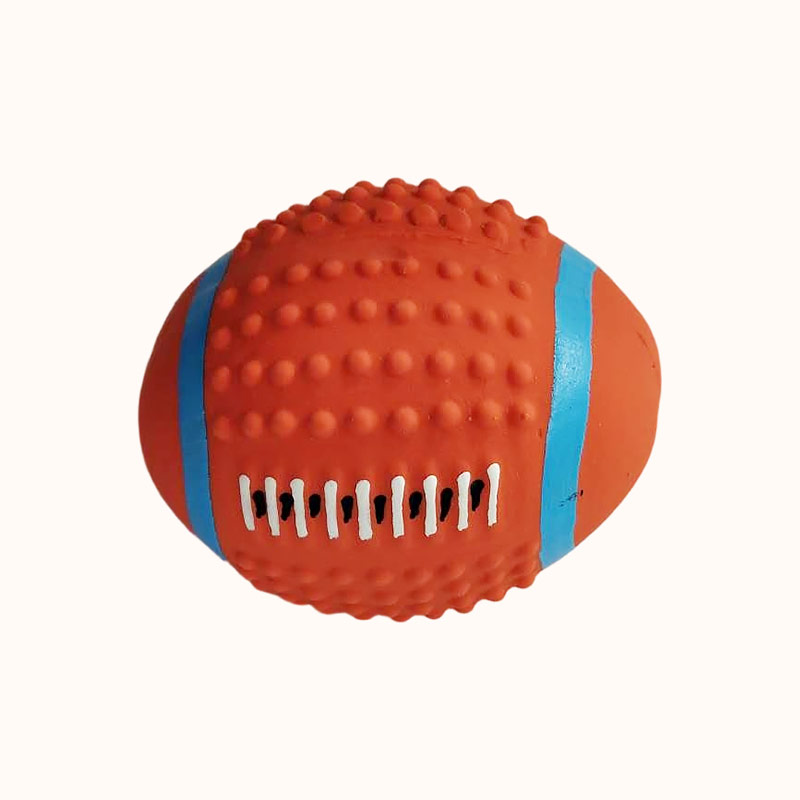
A reference image is useful, but it is not a complete purchase specification. A supplier cannot reliably interpret “make it durable,” “use safe material” or “make it suitable for medium dogs” unless those statements are converted into product characteristics that can be reviewed and approved.
For private label dog toys, the product brief should identify the selected reference model, intended use, target dog size, material to be confirmed, finished dimensions, color requirements, logo method, packaging format and any market-specific documentation the buyer needs. If sound, treat dispensing, floating or another function is important, that function should be named explicitly and verified on the selected sample.
Start With Intended Play Type and the Target Dog
One of the most useful ways to narrow a private label dog toys project is to define how the product is expected to be used before discussing colors or packaging. A product for supervised chewing, interactive play, retrieving or enrichment may require a different geometry and different validation questions.
Define the intended interaction
Write down the primary use in plain language. Is the toy intended mainly for chewing, carrying, tossing, chasing or owner-assisted play? If several uses are intended, rank them. The main use should drive the sample evaluation rather than marketing language being added after the product is chosen.
Define the target size range
“Small,” “medium” and “large” can mean different things across brands. Instead of relying only on category labels, record the finished toy dimensions and the dog profile your merchandising team intends to target. Your final retail claims should remain consistent with the product evidence and local requirements.
Separate visual theme from functional specification
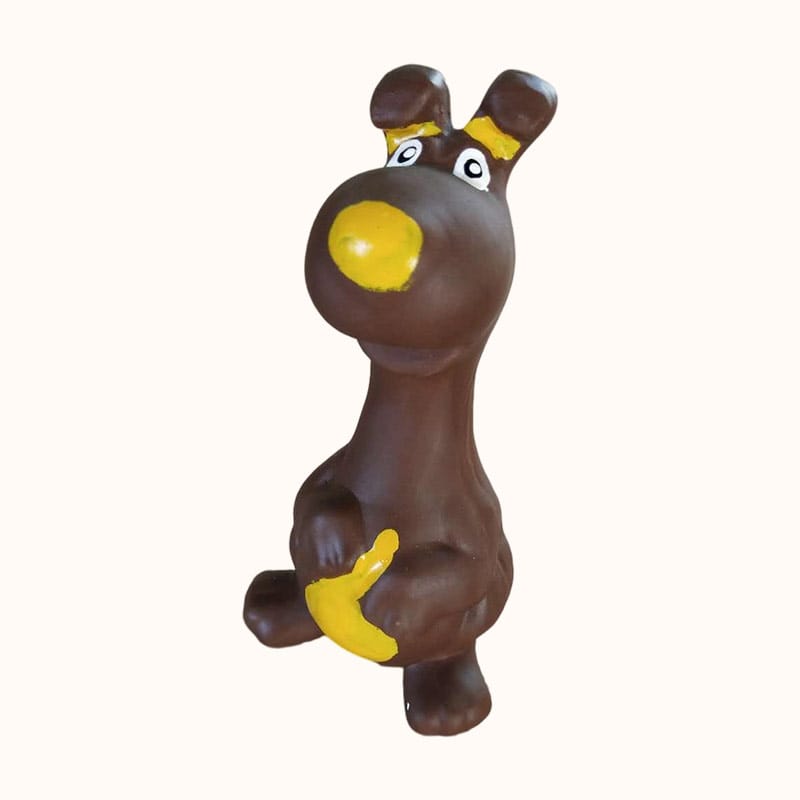
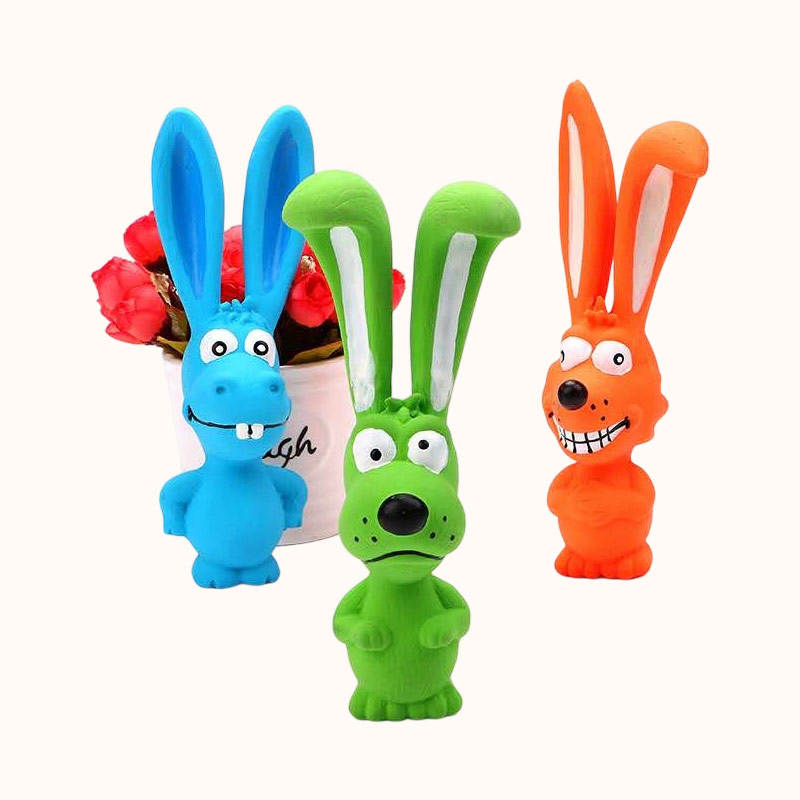
A farm-animal collection, sports-ball collection or cartoon-character range can be commercially coherent, but visual grouping does not mean every item has the same construction. PetProOEM currently shows character designs such as the Cartoon Animal Dog Toy as well as other animal and textured shapes. When sourcing private label dog toys, approve each selected SKU against its own specification rather than assuming one approval applies to an entire themed range.
Confirm the Material for Each SKU, Not Just the Product Category
Material is one of the first questions buyers ask about private label dog toys, but a category-level material statement is not enough to approve a production item. The same website or supplier portfolio may contain different toy materials, formulations or product families. The selected SKU should therefore have a material declaration or specification that matches the sample being approved.
Ask the supplier to identify the material used for the exact product reference. If the product contains more than one material, request the material breakdown by component. For colored molded products, the buyer may also need information about pigments, additives or restricted substances depending on the destination market and the claims being made.
For EU-bound products, chemical obligations can extend beyond a generic “non-toxic” statement. The European Chemicals Agency explains that Candidate List substances in articles can trigger obligations for producers, importers and suppliers, while REACH restrictions can apply to substances in articles. The correct test or documentation scope depends on the material, product and market, so buyers should confirm applicability with a qualified compliance professional rather than copying a test list from another SKU.
When developing private label dog toys, avoid treating “latex,” “rubber,” “TPR,” “silicone” or similar material names as interchangeable. Even when two toys feel similar in the hand, their compositions and performance can differ. Material identity should be tied to the approved sample and the production specification.
Specify Dimensions, Weight and Geometry That Can Be Measured
A private-label sample can look correct in photographs while still differing noticeably in size when it reaches the buyer. Dimensions should therefore be part of the approved specification for private label dog toys.
Depending on the shape, useful measurements may include total length, widest point, maximum height, diameter, opening size and other geometry that affects use or packaging. Weight can also be recorded where it is relevant to consistency, shipping calculations or product handling.
For a character-shaped toy, identify the measurement points clearly. “Height” might mean the base to the top of the head, while ears, horns or another projection could change the maximum overall dimension. Photographs with arrows or a dimension drawing can prevent this ambiguity.
Build a Market-Specific Safety and Compliance File
Buyers often ask for “a certificate” as though one document proves that all private label dog toys are compliant everywhere. A more reliable approach is to start with the destination market, product material and actual construction, then determine which legal requirements, restricted-substance checks and voluntary test methods are relevant.
In the EU, the European Commission explains that the General Product Safety Regulation is part of the framework intended to ensure that safe non-food consumer products are placed on the market. Chemical requirements under REACH may also be relevant. For private label dog toys sold in multiple markets, the compliance file should therefore be planned by destination rather than built around a single generic badge.
| Documentation Area | What the Buyer Should Confirm | Why It Matters |
|---|---|---|
| Product specification | Exact SKU, material, dimensions, color and components | Connects the test and production item to the approved product |
| Chemical scope | Which restricted substances or material tests apply in the destination market | Avoids relying on a generic “safe material” statement |
| Mechanical review | Tests or inspections appropriate to the product construction and expected use | Helps assess foreseeable failure modes |
| Test report identity | Sample description, model reference, material and report date | Helps determine whether the report actually covers the selected SKU |
| Market requirements | Importer, labeling, traceability or responsible-operator obligations where applicable | Supports lawful market placement and traceability |
Create a Sample Approval Sheet for Private Label Dog Toys
The most valuable first-order document is often not a marketing brochure but a sample approval sheet. For private label dog toys, this sheet creates a common reference for purchasing, product development, quality inspection and the supplier.
Start with a unique item code and a dated sample version. Add clear photos from several angles. Record the material information supplied for that SKU, finished dimensions, weight if relevant, color reference, logo location, surface texture and any confirmed function. If there is a squeaker or another inserted component, document its location and expected operation. If no such function is confirmed, leave it out rather than guessing.
PetProOEM’s OEM/ODM service process lists requirement confirmation, sample making, production, inspection, packaging and shipment. A buyer can make that process more controlled by signing off the sample and specification before production, then using the same document during inspection.
Evaluate Construction and Failure Points Before Approving the Sample
A visual check is necessary, but it is not enough for private label dog toys. The buyer should examine how the item is constructed and ask what happens if a dog repeatedly compresses, bends, pulls or chews the product during intended use.
For molded toys, inspect areas where the wall appears thin, where projections join the main body, around openings and around inserted components. For multi-part designs, review attachment points. If the toy includes a sound mechanism, verify that the approved design and test plan address the component and its retention. If the item is intended to dispense treats, assess the opening geometry against the intended treat size rather than assuming any opening will work.
Define Quality-Control Criteria Before Mass Production
Quality control becomes much easier when the acceptance criteria for private label dog toys are agreed before the purchase order moves into production. A factory or inspection team cannot consistently judge “good quality” without measurable checkpoints.
| Inspection Point | Example of a Clear Requirement | Common Ambiguity to Avoid |
|---|---|---|
| Model identity | Matches approved item code and sample version | “Same as picture” |
| Dimensions | Measure agreed points using stated tolerance | “About the same size” |
| Color | Match approved color reference or signed sample | “Bright red” |
| Surface | No unacceptable flash, contamination or visible defects under agreed inspection conditions | “Looks clean” |
| Components | All specified components present and correctly positioned | “Function is normal” without defining function |
| Packaging | Correct label, barcode, quantity, carton marking and pack orientation | “Export packing” |
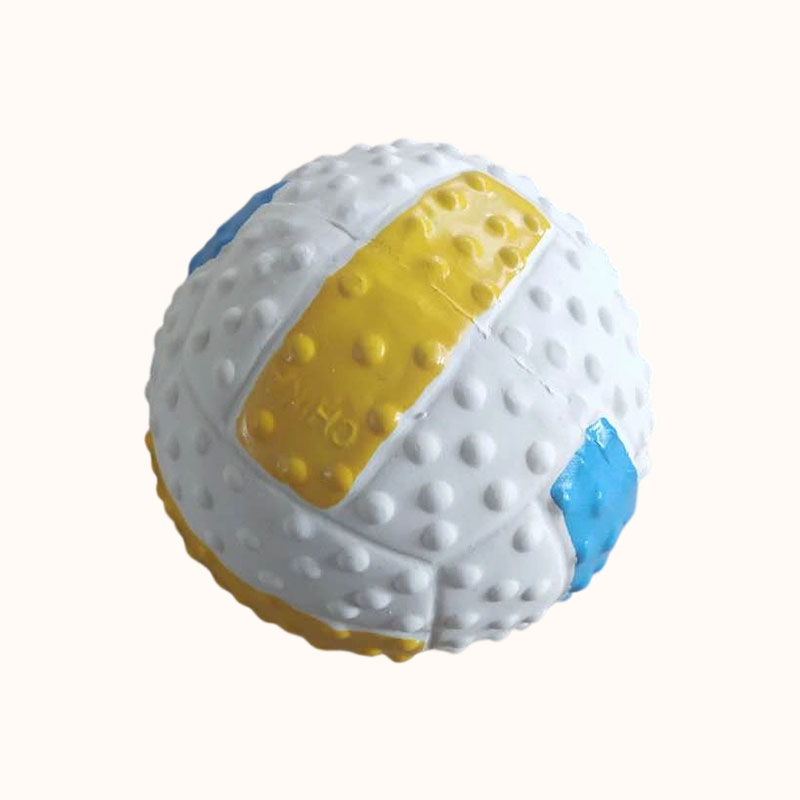
The exact inspection method should be adjusted to the product. A rounded character toy and a textured ball do not necessarily have the same critical dimensions or likely failure points. This is another reason why private label dog toys should be managed at SKU level.
Plan Packaging Around Retail Channel and Product Geometry
Packaging is not an afterthought. It affects how private label dog toys are displayed, identified, shipped and received. Before artwork starts, define the sales channel and whether the item will use a hanging card, belly band, box, bag, label, multi-pack or another confirmed format.
The packaging brief should include the product code, pack quantity, barcode location, language requirements, warning or instruction space where applicable, country-of-origin information if required, and carton markings. The design team also needs accurate product dimensions so photography and dielines are built around the approved item.
For irregular character shapes, check whether protruding ears, beaks, legs or textured surfaces rub against the packaging. For private label dog toys sold in sets, define the exact assortment and color allocation instead of allowing “mixed colors” to remain undefined.
PetProOEM states that its customization services can include logos, labels, packaging formats, outer cartons and product specifications. Buyers should still confirm the available packaging method for the selected toy because capabilities can vary by product and order configuration.
Clarify What “Private Label” Means for Your Project
Not every private label dog toys project requires a completely new shape. A buyer may start from an existing product and customize branding, colors or packaging, or may need a deeper development project. These routes should not be mixed together in the first inquiry.
If you are selecting an existing model, send the exact product link or item reference, required color, logo method and packaging brief. If you need a new shape, provide drawings or reference artwork and ask what development information is required. Do not assume that every change is available without tooling, sampling or engineering review.
Use a Final First-Order Checklist Before Production Release
Before releasing private label dog toys for production, the buyer should be able to answer the following questions from the project file rather than from memory:
- Which exact SKU or approved design is being ordered?
- What material is confirmed for that item?
- What are the agreed dimensions and tolerances?
- What color reference and logo method have been approved?
- Which functional features are confirmed, and how will they be checked?
- Which test reports, declarations or market documents are required?
- Which sample version is the production reference?
- What packaging, barcode, label and carton configuration is approved?
- What inspection criteria will be used before shipment?
- Which details remain conditional and require written confirmation?
If any answer is still “we assumed,” the project is not fully defined. A strong private label dog toys program replaces those assumptions with an approved reference, measurable specifications and clear documentation.
Common Mistakes When Ordering Private Label Dog Toys
The first mistake is approving only appearance. A visually attractive dog toy may still lack confirmed material, dimensions or functional details. The second is copying claims from a similar product. “Durable,” “non-toxic,” “food-grade,” “BPA-free” or “tested to a standard” should be supported for the specific item and market when such claims are used.
A third mistake is treating one report as proof for an entire range. The report identity should be checked against the material, model and sample it actually covers. A fourth is creating packaging artwork before the product dimensions and legal information are finalized. A fifth is failing to retain the approved sample and specification as the reference for production inspection.
Finally, do not assume that a product shape guarantees a function. A football-shaped item may be visually suited to a sports collection, but that alone does not confirm bounce, flotation, treat dispensing or a sound mechanism. When sourcing private label dog toys, every marketed function should trace back to a verified product characteristic.
How Pet Brands Can Make the First Inquiry More Productive
A useful inquiry for private label dog toys does not need to be complicated. It does need to be specific. Start with the product reference or desired shape, intended play type, destination market, target dimensions, required colors, branding method, packaging idea and estimated order volume. Then list the documents or testing questions that matter to your market.
If you are choosing from an existing assortment, browse the Pet Toys category and send links or product references for the designs you want to compare. If you need branding, packaging or a broader development discussion, review the OEM/ODM service options.
For products where material, dimensions or functionality are not shown on the public page, request those details before treating them as part of the specification. This is the most reliable way to move a private label dog toys project from an attractive concept to an order that can be sampled, inspected and repeated.
Conclusion
Successful private label dog toys begin with a controlled product definition. Brand owners should confirm intended use, exact material, dimensions, construction, functions, packaging and market-specific documentation for each SKU. The sample should become a signed reference supported by measurable specifications, not just a photo that “looks right.”
By using the same approved information for quotation, packaging, production and inspection, buyers can reduce ambiguity and build a more repeatable sourcing process. If you are developing a new toy assortment, contact PetProOEM with your selected references, target market and customization brief to discuss appropriate samples and the information needed for your project.
FAQ
What information should I send when requesting private label dog toys?
Send the product reference or design, intended play type, destination market, required dimensions, colors, logo method, packaging format, estimated quantity and any testing or documentation requirements. This gives the supplier enough information to define the project before sampling.
Can I choose a dog toy material only from a website category description?
No. Confirm the material for the exact SKU you intend to order. Category-level descriptions can cover several product families, while the selected item may use a different formulation or construction.
Does an ASTM F963 report automatically certify pet toys for the U.S. market?
No. ASTM F963 is a children’s toy safety standard. The CPSC explains its application to children’s toys. A buyer of pet toys should determine the actual legal and test requirements for the specific product and market instead of presenting a children’s toy report as a universal pet-toy certification.
Should every private-label toy use the same quality-control checklist?
No. A common checklist can cover identity, dimensions, color, packaging and documentation, but critical measurements, functional checks and failure points should be tailored to each toy’s material and construction.
When should packaging artwork be finalized?
Finalize artwork after the product specification and packaging structure are confirmed. The design team needs accurate dimensions, barcode information, required labeling and enough space for any market-specific instructions or warnings before files are released for production.