Chicken jerky for dogs is a familiar product concept, but familiarity alone does not make it the automatic choice for a private label range. Brand buyers comparing chicken and duck jerky need to look beyond the protein name and evaluate the complete formula, guaranteed analysis, texture, portion format, packaging, claims, and the way the product will be positioned in its target market.
That distinction matters because two jerky products can look similar on a product page while being meaningfully different in formulation or commercial use. Conversely, two products based on different meats can share the same supporting ingredients and the same declared analytical values. A useful comparison therefore asks a more precise question: what changes when the primary meat changes, and what does not?
This guide explains how to compare chicken jerky for dogs with duck jerky from a private label buyer’s perspective. It focuses on facts that can be checked in a specification, sample, label draft, or test record rather than relying on broad assumptions about one protein being healthier, more premium, or more suitable for every dog.
Table of Contents
Start With the Full Ingredient List, Not the Front-of-Pack Protein
The first rule when evaluating chicken jerky for dogs is simple: the product name is not the formula. A pack may lead with chicken because chicken is the characterizing meat ingredient, but the finished treat can contain additional ingredients that affect texture, moisture control, processing stability, palatability, and label claims.
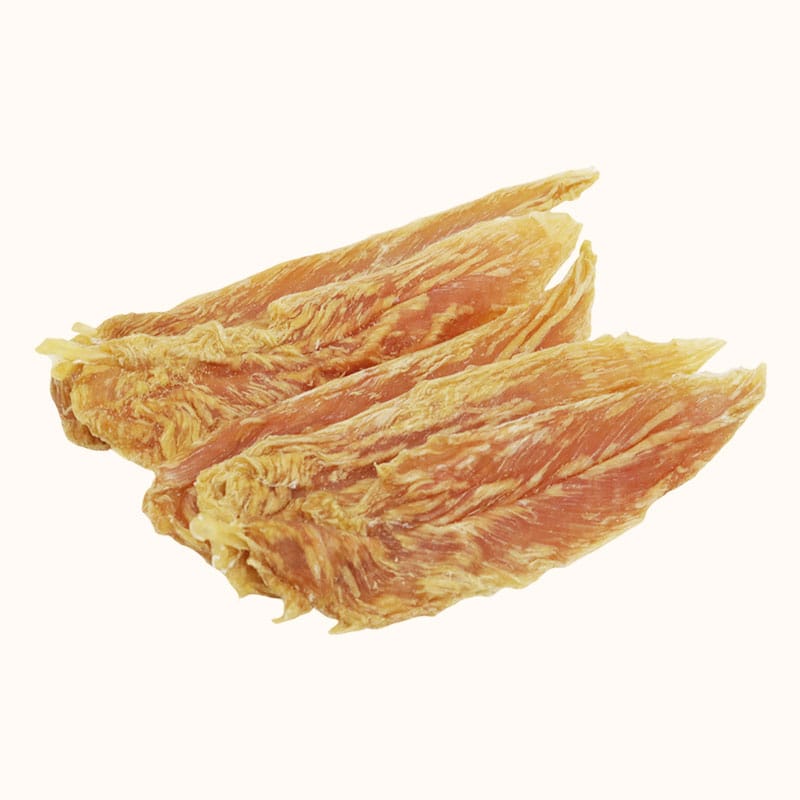
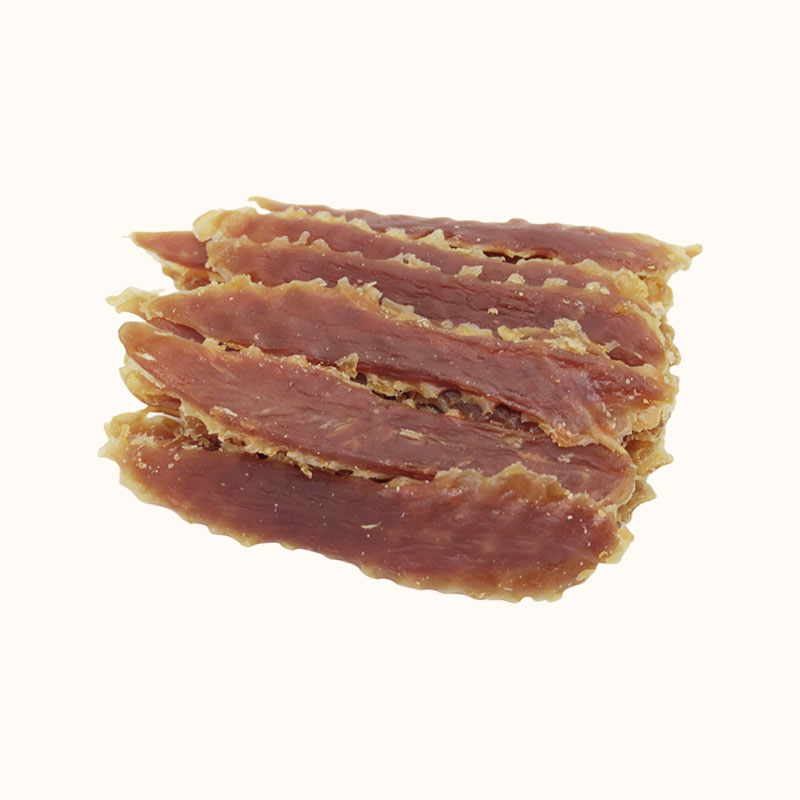
PetProOEM’s Chicken Jerky Whole currently lists chicken, soy protein, corn starch, glycerin, salt, and potassium sorbate. Its Duck Jerky Whole lists duck followed by the same supporting ingredients. That means the verified difference between these two published formulas begins with the primary meat source; it does not justify describing one as a single-ingredient treat, grain-free product, preservative-free product, or limited-ingredient recipe without separate evidence.
This is important for private label development because front-of-pack language often becomes more aggressive during marketing review. A buyer may start with “duck jerky” and later request “single protein,” “limited ingredient,” or “clean label.” Each new phrase creates a new specification question. The formulation must support the claim, and the label should be reviewed for the market where the product will be sold. This is another reason to assess chicken jerky for dogs against the approved product specification.
The U.S. Food and Drug Administration explains that animal food labeling must properly identify the product and list ingredients, while ingredients are generally listed in descending order of predominance by weight. Its animal food labeling guidance is a useful reference when building a label review workflow.
Compare Chicken and Duck as Protein Choices Without Inventing Benefits
When shoppers search for chicken jerky for dogs, they are often comparing proteins at the same time. From a brand perspective, chicken can support a familiar mainstream assortment, while duck can create a differentiated flavor option. Those are positioning observations, not nutritional guarantees.
Do not assume that duck is automatically hypoallergenic. A dog can react to many ingredients, and a finished duck jerky may also contain soy, starch, glycerin, preservatives, or other components. Likewise, chicken should not be described as universally easier to digest or more suitable for training unless the finished product and intended use support those statements.
For private label buyers comparing chicken jerky for dogs with duck jerky, the safer approach is to separate three questions. First, which protein fits the assortment strategy? Second, what is actually in the formula? Third, which claims can be supported by the formula, test data, and applicable labeling rules? This prevents the protein name from becoming a shortcut for claims that have never been verified. This is another reason to assess chicken jerky for dogs against the approved product specification.
A buyer launching chicken jerky for dogs may also choose to add duck as a second SKU because the shared format creates visual consistency across the line. However, this only works commercially if the two products remain easy to distinguish through flavor naming, color coding, imagery, and SKU management.
Use Guaranteed Analysis Correctly When Comparing Jerky Treats
A guaranteed analysis is one of the most useful comparison tools for chicken jerky for dogs, but only when the numbers are interpreted correctly. PetProOEM currently publishes the same analytical guarantees for its whole chicken and whole duck jerky: crude protein at least 55%, crude fat at least 1%, crude fibre no more than 4%, moisture no more than 16%, and crude ash no more than 5.5%.
For chicken jerky for dogs, these declarations do not mean that every production batch contains exactly those values. Minimum guarantees such as crude protein and crude fat are different from maximum guarantees such as moisture and fibre. They also do not tell you how much chicken or duck was added to the recipe. Crude protein is an analytical measure, not a meat inclusion percentage.
The Association of American Feed Control Officials notes that pet food labels typically use minimum guarantees for crude protein and crude fat and maximum guarantees for crude fiber and moisture. Its nutritional labeling resource also points buyers toward laboratory analysis as an important basis for establishing appropriate guarantees.
For a buyer comparing chicken jerky for dogs and duck jerky, ask whether both candidates use the same analytical specification, whether the laboratory method and sampling approach are consistent, and whether additional claims require additional guarantees. If a future formula changes, repeat the review instead of assuming the old specification still applies.
| Comparison point | Chicken Jerky Whole | Duck Jerky Whole | Buyer question |
|---|---|---|---|
| Primary meat | Chicken | Duck | Which protein fits the planned assortment and label positioning? |
| Other published ingredients | Soy protein, corn starch, glycerin, salt, potassium sorbate | Soy protein, corn starch, glycerin, salt, potassium sorbate | Do proposed claims match the complete formula? |
| Crude protein | ≥55% | ≥55% | Is this the approved guarantee for the final customized formula? |
| Crude fat | ≥1% | ≥1% | Do not interpret a minimum as an exact value or a low-fat claim. |
| Moisture | ≤16% | ≤16% | How is moisture controlled and verified for the finished product? |
| Customization | Formula, size, packaging, private label | Formula, size, packaging, private label | Which options are confirmed for the actual project? |
Texture and Breakability Can Matter More Than Protein Name
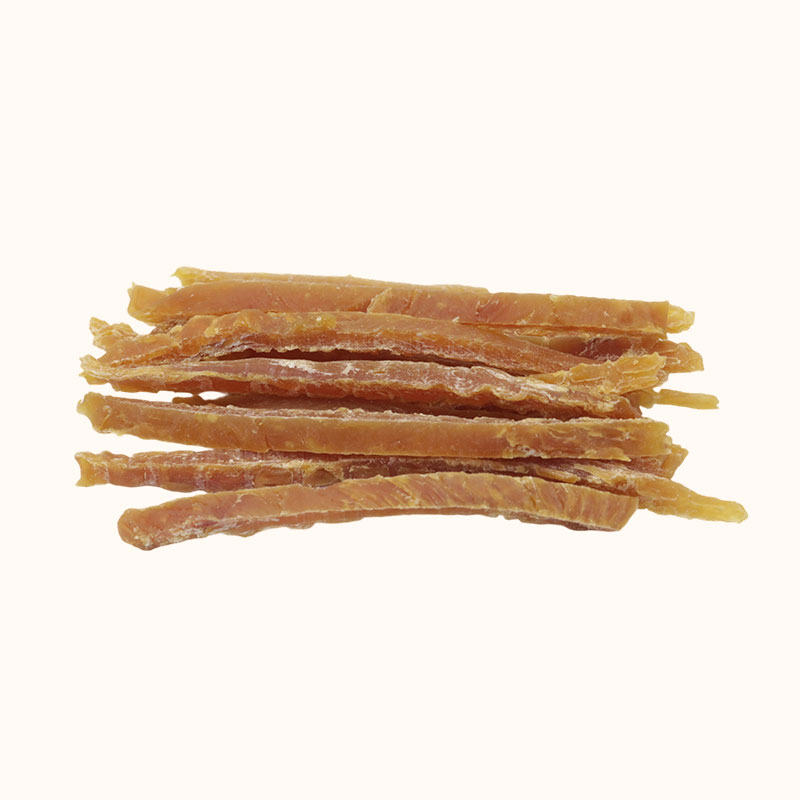
Consumers may discover chicken jerky for dogs through flavor, but they experience the product through texture. Whole jerky strips can be used as occasional rewards, broken into smaller pieces, or positioned as a more substantial chew-like treat depending on thickness and firmness. Those uses should be validated with the actual sample rather than inferred from the word “jerky.”
When reviewing chicken jerky for dogs, examine whether strips bend, snap, tear, or crumble. Record variation in length and thickness. Check whether edges are excessively hard or whether small fragments develop inside the pouch after transport simulation. If the product is intended for training, test how easily a handler can divide it into repeatable portions. If it is intended as a longer reward, confirm whether the selected size and texture actually support that use.
The same approach should be applied to duck. Buyers should not assume that a change in meat source automatically produces a predictable texture. Processing, moisture, supporting ingredients, cut geometry, and drying conditions can all influence the finished result.
For chicken jerky for dogs, this means a useful private label brief should include target strip dimensions, acceptable appearance variation, desired flexibility, and the intended use case. These requirements are more actionable than broad terms such as “premium texture.”
Do Not Turn Flavor Choice Into an Allergy Claim
When chicken jerky for dogs is compared with duck, a private label buyer should be cautious about converting that association into an allergy or hypoallergenic claim. A product can only be assessed based on its complete formulation, manufacturing controls, and the evidence required in the intended market.
If a brand wants to position chicken jerky for dogs as a standard SKU and duck as an alternative, that is a merchandising decision. If it wants to say the duck product is suitable for dogs with allergies, that is a much more specific claim and requires professional review. The presence of soy protein in the published PetProOEM duck formula is another reason not to reduce the product to the word “duck.”
The FDA also warns that animal food claims implying treatment, prevention, or mitigation of disease can raise regulatory issues. Buyers should therefore keep marketing language focused on supported product attributes unless they have the appropriate evidence and regulatory basis for stronger claims.
A practical rule is to write the claim after reviewing the final formula, not before it. This is especially important when OEM development changes ingredients, flavor systems, or processing aids from the reference product.
Packaging Should Protect Texture, Aroma, and Product Identity
Packaging is not a decorative afterthought for chicken jerky for dogs. The bag has to protect the finished treat through filling, storage, export handling, warehousing, and consumer use. It also has to communicate the exact product clearly enough that chicken and duck SKUs cannot be confused.
Start by confirming the net content, pouch dimensions, closure type, barrier requirements, label or printed-film format, outer carton arrangement, coding area, and any market-specific information that must appear on pack. If a zipper is used, test whether it remains practical after repeated opening and whether jerky fragments interfere with closure.
PetProOEM’s OEM and private label services describe customization across labels, packaging, outer cartons, formulas, flavors, and specifications. Treat those as available development areas that still need project-level confirmation.
Inspect filled packages rather than approving artwork on a flat digital mock-up alone. A photograph, protein callout, transparent window, or large flavor word may look different after the pouch is filled. Chicken jerky for dogs should also have a distinct SKU code and carton identification if a duck version is packed in a visually similar format.
Build Claims From Evidence, Not From Category Buzzwords
Chicken jerky for dogs is often surrounded by words such as natural, high protein, grain free, low fat, single ingredient, limited ingredient, human grade, healthy, or hypoallergenic. These terms may have different regulatory implications and should never be added simply because competing search results use them frequently.
The current published chicken formula contains corn starch and potassium sorbate, so the reference product should not be described as grain free or preservative free without a formula change and confirmation. It also contains soy protein, which means “single ingredient” would be inaccurate for the published formulation.
Chicken jerky for dogs can still be marketed effectively without unsupported absolute claims. Buyers can focus on the actual meat source, product format, guaranteed analysis, texture, customization scope, packaging options, and intended reward use. Those attributes give shoppers concrete information instead of vague quality language.
AAFCO’s pet food label guidance explains core label elements and notes that treats are generally not intended to provide complete and balanced nutrition. That distinction is useful when reviewing copy that may accidentally make a snack sound like a complete daily diet.
Use a Matched Sample Test Before Selecting Chicken or Duck
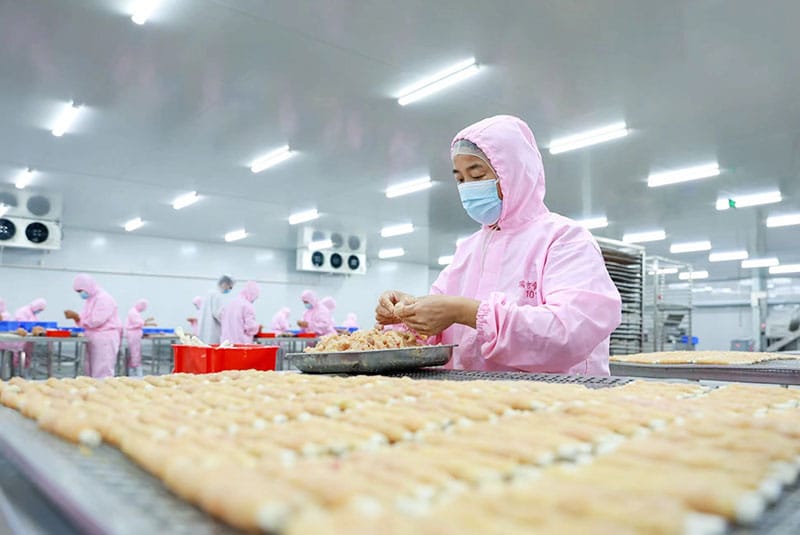
A good chicken jerky for dogs comparison becomes much stronger when both candidate proteins are assessed through the same sample protocol. The goal is not to declare a universal winner. It is to identify which SKU or combination fits the brand’s range and can be produced consistently to an approved specification.
| Sample check | Keep constant | Record | Why it matters |
|---|---|---|---|
| Appearance | Lighting and sample quantity | Color range, shape, surface, visible defects | Supports an objective visual specification. |
| Dimensions | Measurement method | Length, width, thickness range | Helps control portion consistency and pack fill. |
| Texture | Conditioning and handling method | Bend, tear, snap, crumbling | Connects product format with intended use. |
| Aroma | Sample temperature and opening time | Relative intensity and unusual notes | Useful for internal sample comparison. |
| Package integrity | Filled pack and transport simulation | Seal, zipper, puncture, fragments | Protects quality through distribution. |
| Label review | Approved final formula | Ingredients, guarantees, claims, coding | Reduces mismatch between product and artwork. |
If chicken jerky for dogs performs well but the duck version shows more breakage, do not immediately conclude that duck is inherently more brittle. Check whether thickness, moisture, process settings, sample age, or transport conditions differed. The same principle applies to aroma, color, and palatability observations.
Keep retained samples and dated evaluation records for the approved version. When a formulation, ingredient source, strip dimension, process, or package changes, determine which tests need to be repeated. This turns subjective approval into a repeatable quality process.
What to Put in a Private Label Jerky RFQ
An effective RFQ for chicken jerky for dogs should reduce assumptions before samples are made. Start with the target market and sales channel, because packaging and label requirements depend on where and how the product will be sold. Then define the protein, recipe direction, treat format, preferred dimensions, texture goal, net content, pack style, and expected private label scope.
Include the claims you want to explore, but mark them as proposed until the formula and evidence have been reviewed. If you need grain-free, single-ingredient, preservative-free, or another specific positioning, state that requirement at the beginning rather than adding it after a reference sample has already been selected.
Ask for the ingredient statement, guaranteed analysis, product specification, sample identification, available testing information, packaging specification, carton details, coding method, and change-control process. If you are considering both duck and chicken jerky for dogs, request matched samples so the comparison is meaningful.
The PetProOEM dog treats range includes chicken, duck, beef, fish, wrapped treats, and other formats, while the service page describes formula, flavor, size, packaging, and private label development. Confirm the exact options for the product you select rather than treating category-level capabilities as a fixed specification for every SKU.
Conclusion
Chicken jerky for dogs and duck jerky should be compared as complete products, not as isolated protein names. For private label buyers, the most important checks are the full ingredient statement, guaranteed analysis, strip format, texture, sample consistency, packaging, label claims, and the evidence supporting those claims.
The published PetProOEM chicken and duck whole-jerky formulas currently share the same supporting ingredients and analytical guarantees, so the verified difference starts with the meat source. That makes a matched sample test especially useful. Choose the protein that fits your range, but approve the finished specification before building marketing claims around it.
For a private label project, review the Chicken Jerky Whole and Duck Jerky Whole pages, then send your target market, product brief, and packaging requirements to request suitable samples.
FAQ
Is chicken jerky for dogs a single-ingredient treat?
Not necessarily. The current PetProOEM Chicken Jerky Whole page lists chicken, soy protein, corn starch, glycerin, salt, and potassium sorbate. Always check the complete ingredient statement for the specific product instead of inferring composition from the product name.
Is duck jerky automatically better for dogs with allergies?
No. A meat change alone does not establish that a finished treat is hypoallergenic or appropriate for a specific dog. Review the entire formula and obtain appropriate professional guidance for health-related decisions and claims.
Does 55% crude protein mean chicken jerky for dogs contains 55% chicken?
No. Crude protein is an analytical nutrient guarantee, not the percentage of chicken in the recipe. Ingredient inclusion and guaranteed analysis answer different questions and should not be used interchangeably.
What should I compare in chicken and duck jerky samples?
Compare the complete formula, strip dimensions, appearance, texture, breakability, aroma, package integrity, guaranteed analysis, label draft, and any product-specific test information. Keep the test conditions as consistent as possible.
Can a private label chicken jerky formula be customized?
PetProOEM states that formula, size, packaging, and private labeling can be customized for its Chicken Jerky Whole. The exact scope, ingredients, specifications, documentation, quantities, and production conditions should be confirmed for the individual project before approval.