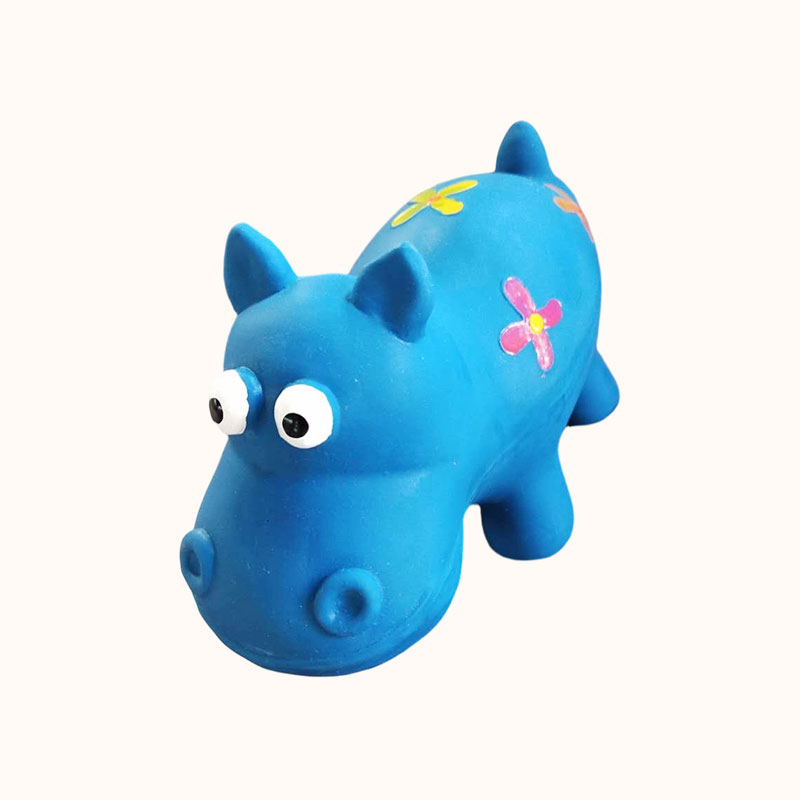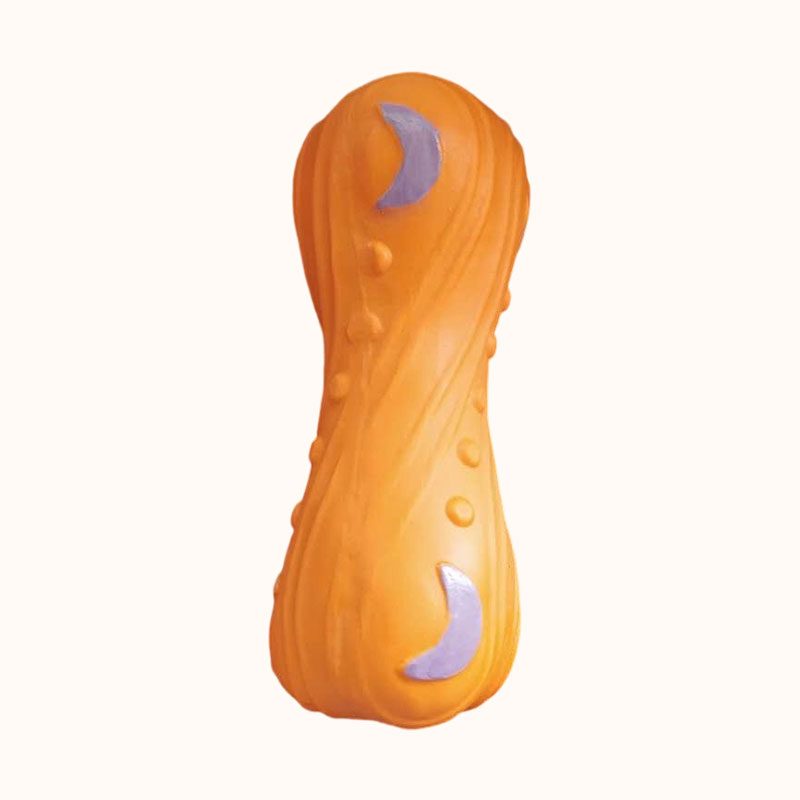
Latex vs rubber dog toys is a common sourcing comparison, but the terminology is often used too loosely. “Latex” can refer to natural rubber latex as a raw material system, while “rubber” may refer broadly to vulcanized natural rubber, synthetic rubber, thermoplastic rubber, or simply a rubber-like material in marketing copy.
For private label buyers, the real question is not whether one label sounds better. It is what material the toy is actually made from, how that material is processed, what hardness and structure the finished SKU uses, and which test reports apply to the exact product.
This guide explains latex vs rubber dog toys from a B2B sourcing perspective. It covers natural latex, vulcanized rubber, TPR, material declarations, hardness, wall thickness, durability, squeakers, pigments, chemical testing, and how buyers should document material identity before approving a private label toy.
Table of Contents
Latex Is Part of the Rubber Material Family
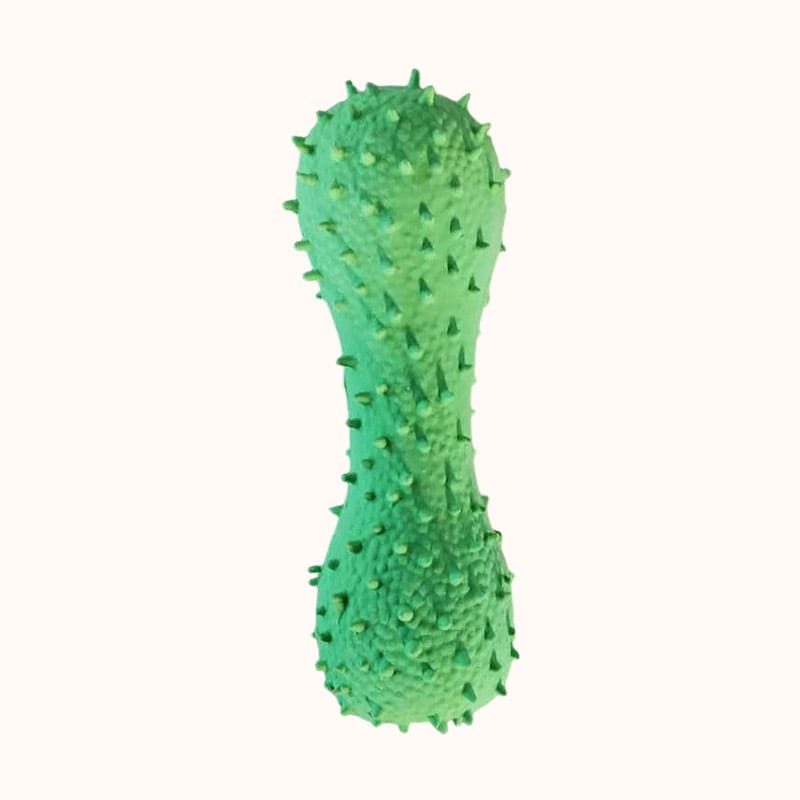
The first thing buyers should understand is that “latex” and “rubber” are not always completely separate categories.
Natural latex is a milky liquid obtained from rubber-producing plants and is used as the starting material for many natural-rubber products. After processing and vulcanization, the material becomes an elastic rubber product.
This is why a sourcing conversation about latex vs rubber dog toys can become confusing. A supplier may call one product “natural latex” and another “natural rubber” even though the materials are technically related.
For procurement, ask for the exact material description instead of relying only on the marketing name.
What PetProOEM Currently States About Its Toy Materials
PetProOEM’s current pet toy category states that its dog chew toy range is made from 100% imported natural latex and is formed in one piece through rotational casting and vulcanization. The same page also lists “Latex material” and “TPR material” as material directions.
This means buyers can currently verify that natural latex is explicitly presented as a material for the main chew-toy range. However, the page also shows a TPR category, so private label buyers should still confirm which material applies to each individual SKU.
For latex vs rubber dog toys, do not assume that every toy on the category page has identical composition, hardness, thickness, or process simply because the range is grouped together.
What Natural Latex Dog Toys Usually Offer
Natural latex toys are often selected for their soft, flexible, squeezable feel. They can be relatively lightweight and can work well for molded character toys, squeaky toys, and softer chew-play formats.
Current market comparisons frequently describe latex as softer and more flexible than dense natural-rubber toys. Buyers can review a current pet toy material comparison for additional market context.
For private label buyers, useful natural-latex questions include:
- What percentage of the material is natural latex?
- What additives or pigments are used?
- How is the material vulcanized?
- What hardness range applies?
- Is the product one-piece molded?
- Is a squeaker inserted?
- What wall thickness applies?
- Which test report matches the SKU?
What “Rubber Dog Toy” Can Mean
The phrase “rubber dog toy” can describe several different material systems.
It may refer to:
- vulcanized natural rubber;
- synthetic rubber;
- a natural/synthetic rubber blend;
- TPR or another thermoplastic elastomer;
- a generic rubber-like material name used in marketing.
This is why latex vs rubber dog toys should never be compared only by product title. The buyer needs the actual material declaration.
TPR Is Not the Same as Natural Latex
TPR usually refers to thermoplastic rubber, a family of materials that combines rubber-like elasticity with thermoplastic processing.
Unlike vulcanized natural rubber, TPR can generally be softened by heat and processed using thermoplastic manufacturing methods such as injection molding.
Current procurement comparisons between TPR and natural rubber focus on differences in processing, hardness, durability, tooling, and supply-chain flexibility. A recent TPR vs rubber dog toy comparison illustrates these sourcing considerations.
For PetProOEM buyers, this distinction matters because the category page lists both natural latex and TPR directions. The buyer should ask which technology and material apply to the selected product.
Do Not Use “Rubber” as a Complete Material Specification
A purchase order that says only “rubber dog toy” leaves too much room for interpretation.
A stronger material specification may include:
| Specification Field | Example Buyer Question |
|---|---|
| Material family | Natural latex, natural rubber, TPR, or other? |
| Material grade | Which supplier grade or internal code applies? |
| Hardness | What Shore hardness or equivalent range applies? |
| Structure | Solid, hollow, one-piece, or multi-component? |
| Color | Which pigment or color code is approved? |
| Components | Squeaker, plug, insert, or other internal part? |
| Testing | Which report applies to this exact material and SKU? |
Hardness Is a Better Procurement Variable Than a Marketing Name
In a latex vs rubber dog toys comparison, hardness gives buyers a more useful technical reference than broad marketing terminology.
Two toys both described as rubber can feel completely different in the hand and behave differently under a dog’s bite.
Hardness affects:
- flexibility;
- compression;
- mouthfeel;
- deformation;
- rebound;
- tear behavior;
- perceived durability.
For latex vs rubber dog toys, ask the supplier to provide an actual hardness range when that parameter is relevant. If hardness changes, confirm whether the formulation also changes.
Wall Thickness Can Matter as Much as Material
Wall thickness is another critical variable in latex vs rubber dog toys because geometry can change durability even when material stays the same.
A thick-walled latex toy may perform very differently from a thin-walled toy made from a stronger compound.
Durability is therefore not determined by material name alone. Wall thickness, geometry, openings, molded transitions, and protruding features all influence failure behavior.
For private label latex vs rubber dog toys, buyers should record:
- minimum wall thickness;
- overall dimensions;
- narrow sections;
- openings;
- seams or molding transitions;
- internal components.
One-Piece Molding Can Reduce Some Construction Risks
Construction method should therefore be reviewed alongside material in any latex vs rubber dog toys sourcing decision.
PetProOEM’s category page states that its natural-latex range is formed in one piece through rotational casting and vulcanization.
One-piece construction can reduce the number of bonded seams or assembled outer parts, but it does not automatically prove that the toy is indestructible.
Private label buyers should still evaluate thin sections, openings, protrusions, squeaker access points, and the overall mechanical performance of the finished product.
Latex vs Rubber Dog Toys and Chewing Intensity

Material suitability depends on the individual dog.
Softer latex may suit gentle or moderate play, while denser rubber-like materials may be selected for more demanding chewing applications. Current consumer guidance often emphasizes that no material is universally suitable for every chewer. Material flexibility, dog size, chewing intensity, and supervision all matter.
For buyers, this means product positioning should use defined terms such as supervised chew play, soft flexible toy, or heavy-duty molded toy only when supported by the actual SKU.
Avoid universal statements such as “for all aggressive chewers” without a test method and evidence.
Very Hard Materials Can Create a Different Risk Profile
Higher hardness is not automatically better.
Very hard chew objects can concentrate bite force on teeth. Veterinary-oriented guidance frequently recommends avoiding extremely hard chew products that do not give under pressure. A current veterinarian-authored chew material comparison discusses hardness and tooth-fracture risk.
For latex vs rubber dog toys, the goal should be appropriate resilience for the intended dog and use—not maximum hardness at all costs.
Squeakers Add Another Material and Construction Question
PetProOEM’s natural-latex series includes squeaky animal toys on the category page.
A squeaker means the product may contain at least one additional internal material or component beyond the outer latex body.
Buyers should confirm:
- squeaker material;
- squeaker size;
- retention method;
- whether it can become accessible after chewing;
- whether the component is included in chemical testing;
- whether sound output needs to be tested.
For latex vs rubber dog toys, the outer material alone is not the complete bill of materials when internal components are present.
Color Changes May Change the Test Basis
Color is not purely cosmetic in a latex vs rubber dog toys program because pigments can affect the chemical composition covered by a report.
Pigments and color additives can change the chemical composition of a toy.
A private label buyer who requests custom colors should ask whether the existing test report covers those colors or whether representative color testing is needed.
This applies to both latex and TPR products.
Do not assume that a report for a yellow toy automatically covers a dark red or black version.
Chemical Testing Should Follow the Actual Material
PetProOEM’s category page states that the full toy range complies with EU EN 71 and U.S. ASTM F963 and is free from BPA, phthalates, lead, cadmium, azo dyes, and other harmful substances.
Private label buyers should request the supporting report for the exact SKU and material rather than applying a category-level statement automatically to every custom version.
For EU-market projects, buyers can also review official REACH information from the European Chemicals Agency when relevant to restricted substances.
For latex vs rubber dog toys, material identification should come before chemical test selection.
ASTM F963 and EN 71 Need Scope Review
ASTM F963 and EN 71 are children’s toy safety frameworks, not universal pet-toy certifications.
The U.S. Consumer Product Safety Commission explains that ASTM F963 applies to children’s toys and that different sections apply to different product types. Buyers can review the CPSC Toy Safety guidance.
If a supplier uses these methods for pet toys, the buyer should ask which sections were tested, what sample was tested, and whether the report matches the final private label SKU.
Material Declarations Should Match Production
A traceable material declaration is one of the strongest controls in a latex vs rubber dog toys private label program.
A good material declaration should identify the product and material clearly enough that buyers can connect it to the approved sample.
For latex vs rubber dog toys, buyers should keep:
- SKU or model number;
- material description;
- material grade or internal code;
- color;
- hardness;
- construction;
- sample code;
- test-report reference.
This creates a stronger change-control baseline for repeat orders.
Do Not Assume “Natural” Means Chemically Untreated
Natural latex still requires processing before it becomes a finished toy.
Vulcanization systems, pigments, stabilizers, fillers, and other processing ingredients can be part of the finished material.
Therefore, “natural latex” should not be interpreted as “one raw ingredient with no additives.”
For private label latex vs rubber dog toys, ask for the finished-material specification rather than only the raw-source description.
Odor Can Be a Material and Processing Indicator
Odor comparison can also be useful during latex vs rubber dog toys sample review, even though it is not a substitute for chemical testing.
Latex and rubber-like materials can have characteristic odors.
Strong or inconsistent odor may be influenced by raw materials, additives, vulcanization, storage, packaging, or production quality.
During sample evaluation, record odor when the package is first opened and after airing.
Odor alone is not a chemical safety test, but major differences between samples can indicate the need for further material review.
Cleaning Claims Need Product-Level Confirmation
Cleaning instructions are another practical difference to verify in latex vs rubber dog toys, especially when materials respond differently to heat or detergent.
Buyers should not assume every rubber-like toy is dishwasher safe, boiling-water safe, or suitable for strong cleaning chemicals.
Heat, detergent, UV exposure, and disinfectants can affect material properties.
For latex vs rubber dog toys, ask the supplier for the recommended cleaning method and verify it on the final product before printing care instructions.
Use Material Naming Consistently Across RFQ, Sample, and Packaging
One of the easiest ways for a latex vs rubber dog toys project to become inconsistent is for different teams to use different material names. Procurement may write “latex,” the supplier may write “natural rubber,” the laboratory report may use a polymer code, and the packaging team may simply print “rubber toy.”
Before mass production, align the terminology. The RFQ, specification, approved sample, laboratory report, artwork, and commercial invoice should refer to the material in a way that is technically accurate and traceable. If the supplier uses an internal material code, keep that code in the specification even if the consumer-facing label uses a simpler material description.
This reduces the risk that a later reorder uses a technically different material while everyone assumes the product is unchanged.
Retest Review Is Important After Material or Color Changes
Private label development often introduces custom colors, adjusted hardness, new squeakers, new wall thicknesses, or even a different material family. Each of those changes can affect the evidence behind a latex vs rubber dog toys claim.
Before accepting an existing test report for a modified toy, ask whether the change affects the tested composition or construction. A new pigment can change chemical coverage. A new hardness can mean a formulation change. A thicker wall can affect mechanical performance. A new internal component adds another material that may need review.
The buyer does not need to retest every cosmetic change automatically, but every change should trigger a documented test-coverage review.
Private Label Sample Comparison Sheet
| Evaluation Point | Latex / Natural Latex | Rubber / TPR Direction |
|---|---|---|
| Exact material | Confirm natural latex specification | Confirm natural rubber, TPR, or other compound |
| Hardness | Record measured range | Record measured range |
| Structure | Solid/hollow/one-piece | Solid/hollow/molded structure |
| Wall thickness | Measure critical sections | Measure critical sections |
| Components | Squeaker or inserts | Squeaker or inserts |
| Color | Approved pigment/color | Approved pigment/color |
| Mechanical test | SKU-specific | SKU-specific |
| Chemical report | Match exact material and color | Match exact material and color |
Private Label Buyer Questions for Latex vs Rubber Dog Toys
A structured question list helps buyers turn latex vs rubber dog toys from a vague material comparison into a controlled sourcing specification.
- What is the exact material?
- Is it natural latex, vulcanized natural rubber, TPR, or another elastomer?
- What material grade or internal code applies?
- What hardness range applies?
- Is the toy solid or hollow?
- What wall thickness applies?
- Is the toy formed in one piece?
- Does it contain a squeaker?
- Which pigments and additives are used?
- Which chemical test report applies?
- Which mechanical test applies?
- Does a custom color require retesting?
- What cleaning method is recommended?
Buyers can review PetProOEM’s current pet toy range and request the material specification for the exact latex or TPR toy being considered.
Common Latex vs Rubber Dog Toy Sourcing Mistakes
Most latex vs rubber dog toys sourcing errors begin when material terminology is accepted without technical verification.
The first mistake is treating latex and rubber as completely unrelated materials.
The second is using “rubber” without an exact material specification.
The third is assuming every PetProOEM toy uses the same material.
The fourth is using hardness as the only indicator of durability.
The fifth is ignoring wall thickness and construction.
The sixth is applying one color’s test report to every custom color.
The seventh is treating ASTM F963 or EN 71 as universal pet-toy certifications without reviewing scope.
Conclusion
The most useful way to compare latex vs rubber dog toys is to move beyond marketing terminology and identify the exact material system. Natural latex belongs to the broader rubber family, while TPR is a thermoplastic rubber-like material with a different processing route. “Rubber” on its own is too broad to control a private label product.
PetProOEM currently confirms a natural-latex chew-toy range and also lists TPR as a material direction. Buyers should therefore verify material at SKU level and link the final material declaration to hardness, construction, color, test reports, and approved sample.
A precise material specification gives brands a stronger basis for product claims, testing, repeat-order consistency, and quality control than the words “latex” or “rubber” alone.
FAQ
Is latex the same as rubber in dog toys?
Latex is related to natural rubber and can be the raw material used to create vulcanized rubber products. In sourcing, “latex” and “rubber” should not automatically be treated as completely separate material families.
What is TPR in dog toys?
TPR stands for thermoplastic rubber. It is a rubber-like thermoplastic material that can be processed differently from vulcanized natural rubber and can offer different hardness, flexibility, and manufacturing characteristics.
Are latex dog toys softer than rubber dog toys?
They often can be, but material name alone does not determine hardness. Buyers should compare the actual hardness, wall thickness, construction, and sample performance of the specific SKU.
Should private label buyers request a material test report?
Yes. Request a report that can be traced to the exact material, color, and product where relevant. Category-level claims should not automatically be applied to every custom SKU.
What should buyers confirm before ordering latex or rubber dog toys?
Confirm the exact material, material grade, hardness, dimensions, wall thickness, construction, color, internal components, mechanical testing, chemical testing, and approved sample reference.