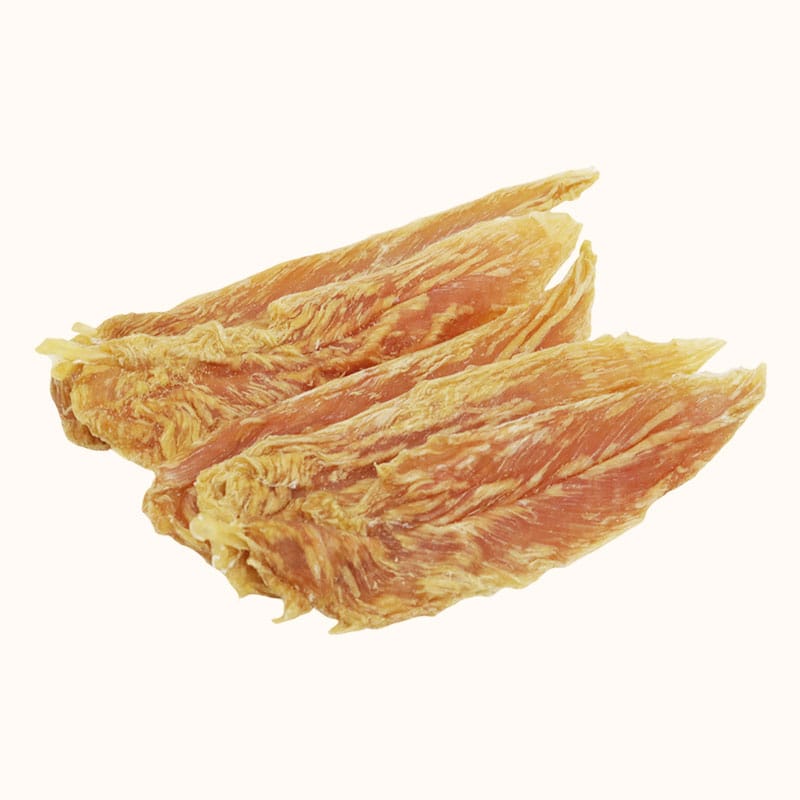
Dog treat ingredients tell private label buyers much more than the flavor name on the front of the pack. A product sold as chicken jerky, duck strip, beef bite, fish snack, or meat-wrapped chew may contain several functional ingredients in addition to the animal protein named in the title.
Those additional ingredients are not automatically a problem. Soy protein, starches, glycerin, salt, preservatives, vitamins, oils, binders, and other components can serve real formulation and processing functions. The purchasing risk appears when buyers assume the product name describes the entire recipe or when marketing claims are approved before the full formula is reviewed.
This guide explains how to evaluate dog treat ingredients from a B2B sourcing perspective. It covers ingredient order, meat-source naming, plant proteins, starches, humectants, preservatives, guaranteed analysis, single-ingredient and grain-free claims, chew-core materials, formula versions, and the documents private label buyers should request before approving packaging.
Table of Contents
Start With the Full Dog Treat Ingredients List
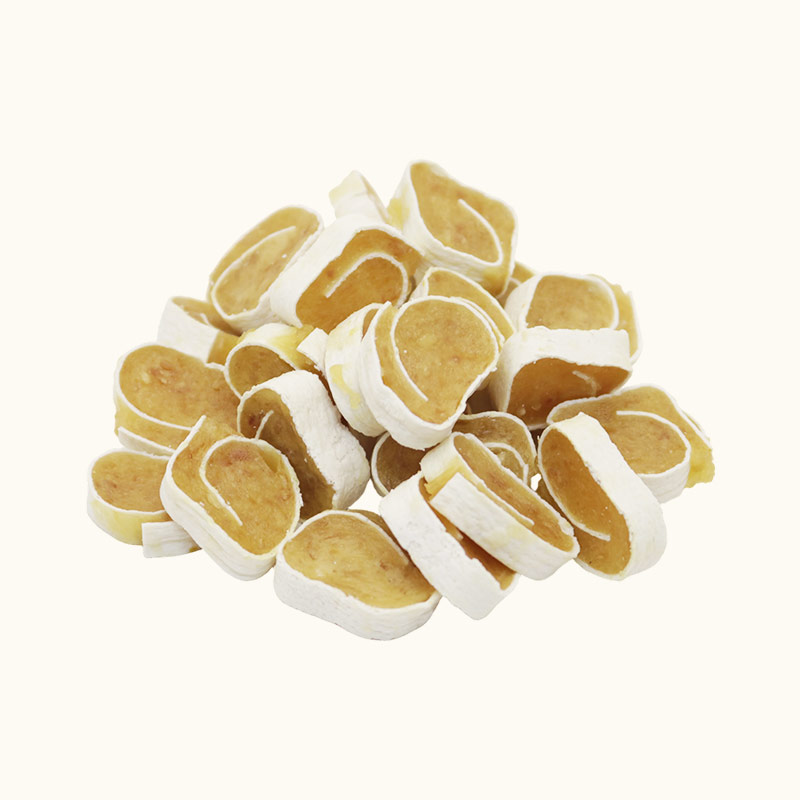
The first step is simple: ask for the complete ingredient statement for the exact SKU.
In the United States, the FDA requires animal-food ingredients to be listed by their common or usual name in descending order of predominance by weight. Buyers can review the agency’s animal food labeling and pet food claims guidance for the federal framework.
This matters because the product name is only one part of the label. A product called “Chicken Jerky” may still contain soy protein, corn starch, glycerin, salt, and preservative. For private label projects, the dog treat ingredients list should therefore be reviewed before the front-of-pack claim is written.
Flavor Name Does Not Equal Formula
One of the most common sourcing mistakes is treating chicken, duck, beef, fish, or rabbit in the product title as though it were the complete formula.
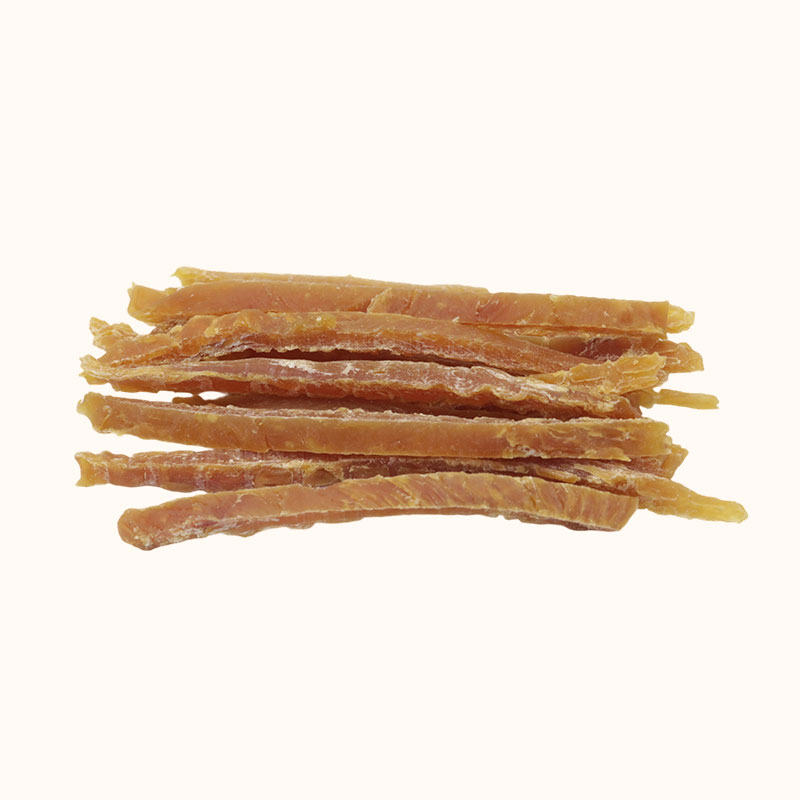
PetProOEM’s current Kyckling Jerky Hela provides a clear example. Its published ingredient list is:
- Chicken
- Soy Protein
- Corn Starch
- Glycerin
- Salt
- Potassium Sorbate
That makes chicken the leading named ingredient, but the product is not a one-ingredient jerky. The full dog treat ingredients list should control any later claims about grain content, preservatives, simplicity, or protein-source exclusivity.
Ingredient Order Gives Buyers Useful Formula Clues
Ingredient order can help buyers understand which components are present in larger or smaller amounts, although it does not reveal the exact formula percentages.
FDA states that pet-food ingredients are listed from most to least by weight. That means a first-listed animal ingredient generally contributes more weight before processing than ingredients listed later, but it does not allow buyers to calculate the exact meat percentage from the label alone.
For dog treat ingredients, use ingredient order to understand formulation structure, not to reverse-engineer exact inclusion rates.
If the brand needs a specific meat percentage, request the formulation specification directly from the supplier rather than estimating from ingredient order.
Named Meat Ingredients Should Be Verified Precisely
Animal-source naming should be consistent across the product title, ingredient statement, technical specification, test documents, and retail packaging.
“Chicken,” “duck,” “beef,” “fish,” “pollock,” “cod,” and “fish skin” are not interchangeable descriptions. If the product title names a specific species, the supporting documentation should use the same identity where required.
This is particularly important for mixed-protein products. A “duck treat” may include chicken or another animal protein in a broth, flavor, binder, or meat blend.
For private label dog treat ingredients, ask the supplier to list every animal-derived ingredient rather than only the headline meat.
Soy Protein Can Affect Both Texture and Claim Strategy
Within a dog treat ingredients review, plant proteins should be evaluated for both their technical role and their effect on claim strategy.
Soy protein is used in some dog treat formulas as a protein source, binder, or texture-supporting ingredient. Its presence changes how the product should be positioned.
PetProOEM’s current Chicken Jerky Whole includes soy protein after chicken. That means buyers should not describe the product as containing only animal protein, even though chicken is the headline ingredient.
Soy is not inherently evidence of poor quality, but it should be transparent. For dog treat ingredients, buyers should ask:
- why soy protein is used;
- whether it can be removed or replaced;
- whether removing it changes texture;
- whether it affects the analytical protein value;
- whether the target market or brand position accepts soy.
Corn Starch Is More Than a Filler Question
Starch is another area where dog treat ingredients influence both texture and front-of-pack positioning.
Starches can support binding, forming, texture, and processing. In jerky-style or shaped treats, they may help create a consistent structure.
PetProOEM’s Chicken Jerky Whole currently lists corn starch. That fact has an immediate marketing implication: the published reference formula should not be described as grain free.
For dog treat ingredients, buyers should separate two questions:
- What technical function does the starch serve?
- Does its presence conflict with the intended claim?
If the brand wants a grain-free product, the formula may need to use another binder or starch system, followed by new sample evaluation.
Glycerin Is Commonly Used as a Humectant
Glycerin should be reviewed as part of the complete dog treat ingredients system rather than judged in isolation.
Glycerin is frequently used in semi-moist animal foods and treats because it helps manage moisture and texture. FDA’s animal-food ingredient framework recognizes that food additives and GRAS substances may be used to alter food characteristics, support stability, or perform other appropriate functions. Buyers can review the FDA’s animal food ingredient information for the broader regulatory context.
In a dog treat formula, glycerin may help maintain a softer, more flexible texture than a fully dried product.
For private label dog treat ingredients, do not interpret glycerin automatically as either “bad” or “premium.” Confirm its source, function, inclusion in the ingredient statement, and whether the finished texture meets the product brief.
Potassium Sorbate Changes Preservative-Free Claims
Preservative review is essential because dog treat ingredients determine whether preservative-free wording is factually supportable.
Potassium sorbate is used as a preservative in many food systems. When it appears in the finished formula, a preservative-free claim should not be used.
PetProOEM’s current Chicken Jerky Whole lists potassium sorbate. Therefore, the current reference formula should not be described as preservative free.
This distinction matters because the PetProOEM dog-treat category also promotes preservative-free and grain-free customization directions. Those category-level options should not be applied automatically to every reference SKU.
For dog treat ingredients, buyers should always review the exact approved formula before transferring a category-level marketing message to product packaging.
Salt Should Be Reviewed as Part of the Complete Formula
Salt can contribute to flavor, formulation, and processing. Its presence should be evaluated as part of the total recipe rather than isolated as a single quality marker.
If the brand wants to make low-sodium or similar nutrition-related claims, the claim should be supported by actual analytical data and reviewed against target-market requirements.
For standard private label development, the useful question is whether salt is present, why it is used, and whether the final formula matches the approved product specification.
Guaranteed Analysis Does Not Reveal the Ingredient Percentages
Buyers frequently confuse guaranteed analysis with recipe composition.
PetProOEM’s current Chicken Jerky Whole publishes:
| Analytical Item | Published Value | What It Does Not Mean |
|---|---|---|
| Crude Protein | ≥55% | It does not mean the formula contains 55% chicken |
| Crude Fat | ≥1% | It does not automatically support a low-fat claim |
| Crude Fibre | ≤4% | It does not identify the source of fiber |
| Moisture | ≤16% | It does not by itself prove shelf stability |
| Crude Ash | ≤5.5% | It does not reveal mineral ingredient percentages |
When reviewing dog treat ingredients, keep the recipe and the guaranteed analysis as two related but separate pieces of information.
Crude Protein Is Not the Same as Meat Content
This distinction deserves special attention because high-protein dog treats are often marketed aggressively.
Crude protein measures nitrogen-based protein content under a defined analytical method. Protein can come from meat, soy protein, and other protein-containing ingredients.
Therefore, a treat with 55% crude protein does not automatically contain 55% meat.
For private label buyers, meat inclusion should be confirmed from the formula or supplier specification if it is an important product claim.
Single Ingredient Must Be Verified Literally
A single-ingredient claim should mean that the finished product contains one declared ingredient.
If the dog treat ingredients list contains chicken, soy protein, corn starch, glycerin, salt, and potassium sorbate, the product is not single ingredient.
Likewise, “single protein” is not the same as “single ingredient.” A treat may contain one animal protein but several non-animal ingredients.
Buyers should decide which concept they actually need:
- single ingredient;
- single animal protein;
- limited ingredient;
- high meat;
- grain free;
- preservative free.
Each claim requires separate verification.
Grain Free Must Be Checked Against Every Formula
Grain-free positioning is popular in pet products, but it should never be inherited automatically from a category page.
Corn starch is present in the current Chicken Jerky Whole reference formula. Therefore, that SKU should not be marketed as grain free in its current published form.
A customized grain-free version may be possible, but the revised formula, ingredient list, texture, analysis, shelf-life basis, and sample should be reviewed again.
For dog treat ingredients, claim verification should happen after formula approval—not before.
Preservative Free and No Added Preservatives Are Different Discussions
Buyers should be precise when using preservation claims.
A product containing potassium sorbate clearly should not be described as preservative free. A product with no separately added preservative may still rely on drying, water-activity control, packaging barrier, antioxidants, or other processing systems for stability.
The buyer should ask:
- Are preservatives added?
- Are antioxidants used?
- How is moisture controlled?
- What is the water-activity target if relevant?
- How is shelf life supported?
- Does changing the preservative system require new validation?
Chew Products Need Core-Material Transparency
For wrapped chews, dog treat ingredients include the chew core as well as the visible meat layer and supporting formulation.
For wrapped chews, the visible meat may cover another material such as rawhide, collagen, cartilage, bone, or another chew core.
That core belongs in the dog treat ingredients review and in the product-positioning decision.
PetProOEM’s 5 Rawhide Stick med Duck explicitly identifies a rawhide core with duck meat. Buyers should not reduce that product to “duck treat” when the chew structure is a major part of what consumers are purchasing.
Composite Treats Need Extra Ingredient Review
Products such as meat sandwiches, wrapped bones, meat-and-pumpkin combinations, or composite bites can contain several material layers.
For these products, buyers should review:
- outer meat layer;
- inner core;
- binders;
- starches;
- humectants;
- preservatives;
- flavoring ingredients;
- vitamins or functional additives.
A single product name may hide multiple formulation systems.
Flavor Claims Should Match the Animal-Protein Profile
Dog-treat flavor naming should remain consistent with the actual formula.
A “duck” product that also contains chicken should not create the impression of a duck-only recipe. A fish product should use consistent fish-species naming across technical documents and packaging.
For private label dog treat ingredients, ask for a species-level animal-protein summary when single-protein positioning matters.
Do Not Turn Ingredient Presence Into a Health Claim
Ingredients can support factual product descriptions without proving medical or physiological outcomes.
Examples:
- duck does not automatically mean hypoallergenic;
- fish does not automatically prove skin-and-coat benefits;
- pumpkin does not automatically prove digestive support;
- a textured chew does not automatically prove dental cleaning;
- vitamin C does not automatically create an immune-support claim.
FDA notes that claims implying treatment, prevention, or mitigation of disease can affect the regulatory status of animal products. Keep dog treat ingredients claims grounded in what the formula and evidence actually support.
Formula Version and Sample Version Must Match
Version control prevents outdated dog treat ingredients from being carried into final artwork after the formula has changed.
Private label dog treats often go through several sample rounds. A supplier may change moisture, thickness, binder level, preservative system, or texture after buyer feedback.
If the formula changes, the ingredient list may also change.
For dog treat ingredients, every approved sample should be linked to:
- formula version;
- sample code;
- ingredient statement;
- analysis;
- piece specification;
- package version;
- claim set.
This prevents artwork from being built on an outdated ingredient list.
Ingredient Transparency Should Continue Into Repeat Orders
The first order is not the end of formula control.
Buyers should ask the supplier to notify them before changing a major dog treat ingredients component, raw-material source where contractually relevant, preservative system, binder, meat species, or other critical formulation element.
Even a technically small change can affect claims, texture, analysis, shelf life, or consumer acceptance.
Repeat-order change control is especially important for brands that print the ingredient list directly onto preprinted packaging.
Private Label Dog Treat Ingredient Review Checklist
| Review Area | Buyer Question |
|---|---|
| Headline meat | Does the named flavor match the actual primary animal ingredient? |
| Other animal proteins | Are secondary species, broth, or flavors used? |
| Plant protein | Is soy or another plant protein present? |
| Starch / binder | Which starches or binders are used and why? |
| Humectant | Is glycerin or another moisture-control ingredient present? |
| Preservative | Is potassium sorbate or another preservative used? |
| Chew core | Is rawhide, collagen, bone, cartilage, or another core present? |
| Analysis | Which values are minimums, maximums, targets, or test results? |
| Claims | Are single ingredient, grain free, high meat, or preservative-free claims supported? |
| Version control | Does the ingredient statement match the approved sample? |
Questions to Ask a Dog Treat Supplier
- What is the complete ingredient list for this SKU?
- Which ingredients are animal derived?
- Are multiple animal proteins present?
- Is soy protein used?
- Which starch or binder is used?
- Is glycerin used as a humectant?
- Are preservatives used?
- What chew core is present, if any?
- What guaranteed analysis applies?
- What is the meat inclusion percentage if the brand needs that claim?
- Which claims are supported by the current formula?
- What changes are possible for a private label version?
- Will formula changes require a new sample and analysis?
Buyers can review PetProOEM’s current dog treat range and request the current ingredient specification for the exact treat or chew being considered.
Common Dog Treat Ingredient Mistakes
The first mistake is treating the flavor name as the complete formula.
The second is reading crude protein as meat percentage.
The third is assuming a chicken or duck jerky is single ingredient.
The fourth is using a grain-free claim when the formula contains corn starch or another grain ingredient.
The fifth is using preservative-free language when potassium sorbate or another preservative is present.
The sixth is ignoring rawhide, bone, cartilage, or another chew core.
The seventh is approving artwork from an outdated formula version.
Conclusion
The most useful way to review dog treat ingredients is to read beyond the flavor name. Animal proteins, plant proteins, starches, glycerin, salts, preservatives, chew-core materials, and other functional ingredients all contribute to the final product and determine which marketing claims are accurate.
PetProOEM’s current Chicken Jerky Whole is a useful example. Its published formula contains chicken, soy protein, corn starch, glycerin, salt, and potassium sorbate, with crude protein listed at ≥55%. Those facts mean the reference SKU should not be interpreted as single ingredient, grain free, preservative free, or 55% chicken simply because of its name or analysis.
For private label buyers, the strongest process is to request the current formula, link it to the approved sample, verify every intended claim, and keep ingredient change control in place for repeat orders.
FAQ
What should buyers look for in dog treat ingredients?
Review the complete ingredient list, animal-protein sources, plant proteins, starches, binders, humectants, preservatives, chew-core materials, additives, and the relationship between the formula and intended marketing claims.
Does high crude protein mean a dog treat contains a high percentage of meat?
Not necessarily. Crude protein measures analytical protein and can come from both animal and plant ingredients. Meat inclusion percentage must be confirmed from the formulation.
Is chicken jerky always a single-ingredient dog treat?
No. Chicken jerky can contain soy protein, starches, glycerin, salt, preservatives, or other ingredients depending on the recipe. Always check the complete ingredient statement.
Does corn starch prevent a grain-free claim?
Yes, a formula containing corn starch should not be marketed as grain free unless the formulation is changed and the final ingredient list supports the claim.
What should private label buyers request before approving dog treat packaging?
Request the current ingredient statement, formula version, approved sample code, guaranteed analysis, product specification, claim support, shelf-life basis, and final packaging text for the exact SKU.