Understanding complete vs complementary cat food is essential before a private label buyer approves a wet cat food formula, package, feeding statement, or front-of-pack claim. Two products can look almost identical in a pouch, can, cup, or tray while serving very different nutritional roles.
A complete food is intended to provide the nutrients required for the stated species and life stage when fed as directed. A complementary food is intended to be fed with other food or used in a more limited role, such as a topper, treat, snack, or supplemental product. That distinction affects formulation, label language, feeding instructions, product positioning, and the evidence a buyer should request from a supplier.
For brands developing wet cat food, the question of complete vs complementary cat food should be settled before marketing language is finalized. Product names such as “staple food,” “daily meal,” “soup,” “mousse,” or “cup food” do not by themselves establish nutritional adequacy. The formula and supporting nutritional basis do.
Table of Contents
What Does Complete vs Complementary Cat Food Actually Mean?
The difference between complete vs complementary cat food is primarily about whether the product can provide the full daily ration on its own for the stated cat and life stage.
In the United States, the U.S. Food and Drug Administration explains that a pet food labeled “complete and balanced” is intended to be fed as a pet’s sole diet and should meet an accepted nutritional adequacy basis, commonly through an AAFCO nutrient profile or an appropriate feeding trial. Buyers can review the FDA’s guidance on complete and balanced pet food.
In Europe, Regulation (EC) No 767/2009 defines complete feed as compound feed sufficient for a daily ration because of its composition. Complementary feed is sufficient for a daily ration only when used in combination with other feed. The regulation is available through EUR-Lex.
FEDIAF similarly explains that complete pet food provides the nutrients a pet requires each day when fed as instructed, while complementary pet food is intended to be mixed with other food or used as a snack or treat. Its nutritional guidelines are a useful reference for European product development.
Why Complete vs Complementary Cat Food Matters to Private Label Buyers
For a consumer, complete vs complementary cat food affects how the product fits into the cat’s diet. For a private label buyer, the distinction affects nearly every stage of product development.
In a complete vs complementary cat food project, a complete wet cat food generally requires a formulation that meets the intended nutritional standard for the relevant life stage. This can influence ingredient selection, vitamin and mineral supplementation, taurine levels, analytical targets, feeding instructions, energy calculations, and label wording.
A complementary product can be commercially valuable without serving as the entire diet. Broths, toppers, treats, meat strips, soups, or highly palatable supplementary foods may be intentionally designed for limited feeding. The problem arises when a complementary food is marketed as though it were a nutritionally complete daily diet.
This is why complete vs complementary cat food should be one of the first questions in a private label RFQ, not a final label decision made after the product is already developed.
Do Not Use the Product Name as Proof of Nutritional Completeness
One of the biggest mistakes in complete vs complementary cat food sourcing is treating commercial naming as nutritional evidence.
PetProOEM currently lists a product called อาหารหลักถ้วยพลาสติก. Its page describes pudding, mousse, and milkshake-style textures in 50–55 g cups and states that the formula can be used as daily staple food and complementary food. Because those are different nutritional roles, a buyer should not assume that every formula offered in this cup format is automatically nutritionally complete.
The correct approach is to confirm the exact formula, intended species, life stage, nutritional adequacy basis, feeding instructions, and supporting documentation for the specific SKU.
The same principle applies to other product names. “Meal,” “dinner,” “staple,” “soup,” “broth,” “snack,” and “treat” can communicate positioning, but they do not replace a formal nutritional adequacy statement.
Complete Cat Food Requires More Than High Protein
A common misconception in the complete vs complementary cat food discussion is that a high-meat or high-protein product must be complete. Nutritional completeness is broader than protein percentage.
Cats require appropriate amounts and relationships of protein, essential amino acids, fatty acids, vitamins, minerals, and other nutrients. Taurine is especially important for cats, but even a product containing adequate taurine still cannot be called complete solely on that basis.
Likewise, a recipe dominated by meat or fish can still be nutritionally incomplete if it lacks the correct balance of minerals, vitamins, essential fatty acids, or other required nutrients.
For private label development, buyers should ask what nutritional framework the formula is designed to meet and for which life stage. A statement such as “high protein” is a product attribute; it is not a substitute for a complete nutritional adequacy basis.
Life Stage Is Part of the Complete vs Complementary Cat Food Decision
The question of complete vs complementary cat food cannot be separated from life stage. A food suitable as a complete diet for adult maintenance is not automatically appropriate for growth or reproduction.
Private label buyers should define whether the product is intended for adult cats, kittens, growth and reproduction, or another recognized nutritional category in the target market. Avoid using broad statements such as “for all ages” unless the formulation and nutritional evidence genuinely support the applicable all-life-stage requirements.
This matters because growth and reproduction generally impose higher or different nutritional requirements than adult maintenance. A formula can be complete for one life stage without being formulated for another.
Therefore, the label should clearly connect nutritional adequacy with the intended life stage rather than using vague universal wording.
Wet Cat Food Format Does Not Determine Whether It Is Complete
Pouches, cans, cups, trays, broths, and mousse textures can all appear in the wet cat food category, but package type does not decide complete vs complementary cat food.
A pouch can contain a complete diet or a complementary topper. A can can contain a complete diet or a limited-use product. A plastic cup can contain a mousse-style food that is nutritionally complete, or a snack that is intended only for supplemental feeding.
| Product Format | Possible Nutritional Role | What the Buyer Must Confirm |
|---|---|---|
| Pouch | Complete or complementary | Formula, adequacy statement, life stage, feeding directions |
| Can | Complete or complementary | Nutritional basis, ingredients, analysis, intended use |
| Cup | Complete or complementary | Exact formula and supporting nutritional documentation |
| Broth or soup | Often complementary, but confirm | Whether it is a topper, snack, hydration product, or complete food |
| Strip or treat format | Typically limited-use, but confirm | Feeding purpose and label classification |
This is an important sourcing rule: classify the food by its nutritional design, not by its container.
How to Read the Nutritional Adequacy Statement
When evaluating complete vs complementary cat food, private label buyers should pay particular attention to the nutritional adequacy statement required or expected in the destination market.
For U.S.-market products, a complete and balanced statement should identify the species and relevant life stage and state the basis for nutritional adequacy. Products intended only for intermittent or supplemental feeding should be identified accordingly.
For EU-market products, the complete or complementary designation is part of the feed classification and should align with the composition and intended feeding use.
Do not approve packaging simply because the front panel says “daily nutrition.” Review the legally relevant designation, feeding directions, analytical information, ingredient list, and any supporting documents together.
Guaranteed Analysis Alone Cannot Prove Complete Nutrition
Another frequent error in complete vs complementary cat food comparisons is relying on a short guaranteed analysis panel as proof of nutritional completeness.
A typical wet cat food analysis may show crude protein, crude fat, crude fibre, moisture, and ash. Those numbers are useful, but they do not show every essential nutrient required for a complete diet.
The FDA also notes that wet and dry products with very different moisture levels cannot be compared directly using only as-fed percentages. For a meaningful nutrient comparison, values may need to be converted to a dry-matter basis.
For example, a wet food with 10% crude protein and 80% moisture contains 20% dry matter. On a dry-matter basis, crude protein would be approximately 50%. That conversion can help compare nutrient concentration across products with different moisture levels, but even then, a high protein value still does not establish nutritional completeness.
Complete vs Complementary Cat Food: Buyer Documentation Checklist
Before approving a formula, a private label buyer should collect enough documentation to establish the intended role of the product. For complete vs complementary cat food, a practical checklist includes:
| Document or Information | Why It Matters |
|---|---|
| Formula or ingredient specification | Confirms the composition of the approved SKU |
| Nutritional adequacy basis | Supports complete-food positioning where applicable |
| Life-stage statement | Defines the population for which the food is intended |
| Guaranteed analysis / analytical constituents | Provides declared nutrient information |
| Feeding instructions | Shows how the product is intended to be used |
| Calorie or energy information where required | Supports feeding guidance and market requirements |
| Final ingredient list | Must match the approved formula |
| Artwork and label version | Ensures claims and product classification match the SKU |
| Market-specific compliance review | Checks whether the final wording fits destination requirements |
The exact documentation will vary by market, but the key principle remains the same: nutritional positioning should be traceable to the approved formula.
How Complementary Cat Food Can Fit a Strong Product Range
In the complete vs complementary cat food category, complementary does not mean inferior. In the complete vs complementary cat food discussion, each category serves a different role.
Complementary foods can create variety, improve palatability, add moisture, serve as treats, work as toppers, or provide a different eating experience. A soup, broth, mousse, meat strip, or small cup can be commercially attractive even when it is not designed to provide the entire daily ration.
The key is honest positioning. A complementary product should be marketed as what it actually is rather than being presented as a nutritionally complete meal.
For a private label portfolio, complementary products can sit alongside complete foods. One range can contain a core daily diet plus toppers, snacks, treats, and hydration-oriented formats, provided the packaging clearly distinguishes their roles.
How Complete Cat Food Changes Formula Development
When a buyer chooses the complete side of the complete vs complementary cat food decision, product development becomes more nutrition-driven. That is why complete vs complementary cat food should be defined before formula optimization begins.
The supplier or formulation team must work toward the applicable nutrient requirements for the intended market and life stage. Ingredient changes cannot be considered only in terms of flavor or cost because they may affect nutrient balance.
For example, changing the main protein source may alter amino acid composition, fat profile, mineral contribution, palatability, and processing behavior. Adjusting water content can change nutrient concentrations on an as-fed basis. Removing or replacing a premix can materially affect nutritional adequacy.
This means that substantial formula changes should trigger a nutritional review rather than being treated as simple flavor changes.
How Complementary Products Can Offer More Formulation Flexibility
Complementary products may offer more flexibility in texture, ingredient simplicity, broth content, or treat-like positioning because they are not necessarily designed to provide the full daily nutrient requirement.
However, that flexibility does not eliminate the need for accurate labeling. In a complete vs complementary cat food project, the buyer should still define ingredients, analysis, feeding purpose, package format, storage, and appropriate feeding instructions.
Complementary products should also avoid implying that they replace a complete diet when they do not.
Private Label Packaging Should Make the Difference Clear
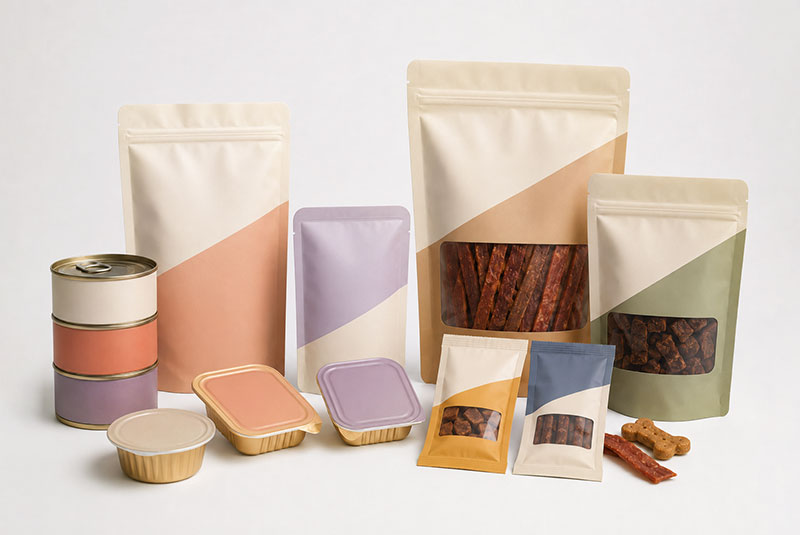
The distinction between complete vs complementary cat food should not be buried beneath marketing language. Buyers should make sure the package communicates the product role clearly enough for consumers to use it correctly.
Front-of-pack design can emphasize flavor, texture, protein source, or serving occasion, but the legally relevant product designation and feeding guidance must remain accurate.
For complete foods, the package may focus on daily feeding and life-stage suitability when supported. For complementary products, wording can emphasize topper, treat, snack, broth, or supplemental feeding use where appropriate.
PetProOEM’s OEM and ODM service describes customization of formulas, specifications, packaging, labels, and outer cartons. Buyers should make sure each artwork version is linked to the exact approved formula so that a complementary formula does not accidentally receive complete-food wording.
Common Complete vs Complementary Cat Food Mistakes
The first mistake is assuming that a product called “staple food” must be complete. A commercial product name is not a nutritional adequacy statement.
The second is assuming that a high meat percentage or high crude protein value proves complete nutrition. Complete nutrition depends on the full nutrient profile.
The third is using the same feeding instructions for both complete and complementary products. Their intended roles are different.
The fourth is using “all life stages” without confirming the applicable nutritional basis.
The fifth is approving label claims before the final formula is approved.
The sixth is assuming that every wet cat food pouch or can is a complete diet. Package format does not determine nutritional role.
The seventh is treating complementary food as a lower-quality category. A well-designed complementary product can be highly valuable when its role is clear.
Complete vs Complementary Cat Food RFQ Questions
Before asking for a quotation, private label buyers can use the following questions:
- Is the product intended to be complete or complementary?
- Which species and life stage is the formula designed for?
- What nutritional standard or adequacy basis supports the complete-food claim?
- Is the current formula already established, or will it be customized?
- Which formula changes require nutritional reassessment?
- What ingredient list applies to the sample?
- What guaranteed analysis or analytical constituents are available?
- What feeding instructions are recommended?
- What package formats and net weights are available?
- Which label statements are supported for the target market?
- Which documents can be provided for the approved SKU?
- Will a formula change require a new sample, label, or test?
Buyers can review PetProOEM’s wet cat food range and send a product brief specifying the intended nutritional role, texture, package format, target market, and customization requirements.
Conclusion
The most important lesson in complete vs complementary cat food sourcing is that nutritional role must come from the formula and its supporting basis—not from the product name, package type, meat content, or marketing language.
A complete food is developed to provide the full daily ration for the stated species and life stage when fed correctly. A complementary food has a different role and may function as a topper, snack, broth, treat, or supplemental product. Both can be valuable, but they should not be confused.
For private label buyers, confirm the nutritional category before approving the formula, sample, feeding instructions, and artwork. This creates clearer product positioning, more defensible claims, and fewer problems when the product reaches the target market.
FAQ
What is the difference between complete and complementary cat food?
Complete cat food is intended to provide the nutrients required for the stated cat and life stage when fed as directed. Complementary cat food is intended to be combined with other food or used as a snack, treat, topper, or supplemental product.
Can complementary cat food be fed every day?
It may be used regularly according to its feeding instructions, but it should not automatically replace a complete diet if it is not nutritionally complete. The label and product documentation should define its intended use.
Does high protein mean a cat food is complete?
No. Protein is only one part of feline nutrition. Complete nutrition also depends on appropriate amino acids, fatty acids, vitamins, minerals, and other nutrients in the correct amounts and relationships.
Can wet cat food in cups or pouches be complete?
Yes. Package format does not determine nutritional role. A cup, pouch, can, or tray can contain either complete or complementary cat food depending on the formula and supporting nutritional basis.
What should a private label buyer request before using a complete-food claim?
Request the approved formula, intended species and life stage, nutritional adequacy basis, relevant analytical information, feeding instructions, final ingredient list, and the market-specific label documentation needed to support the claim.