Dog treat packaging has to protect more than the visual identity of a brand. It must help maintain texture, aroma, moisture balance, cleanliness, label accuracy, and retail presentation while surviving filling, warehousing, export handling, shelf display, and repeated opening after purchase.
For private label buyers, packaging should be selected around the treat itself. A soft chicken strip, dry jerky, training bite, meat-wrapped chew, and larger rawhide product may need different pack dimensions, barrier performance, closure systems, and retail presentation. A package that works well for one SKU should not automatically be copied across an entire treat range.
This guide explains how to evaluate dog treat packaging for private label programs. It covers pouch types, closures, barrier requirements, clear windows, pack size, artwork, labels, barcodes, multilingual packaging, outer cartons, e-commerce handling, export protection, sample approval, and the packaging information buyers should confirm before production.
Table of Contents
Start Dog Treat Packaging With the Product Format
The treat format should come before the pouch style.
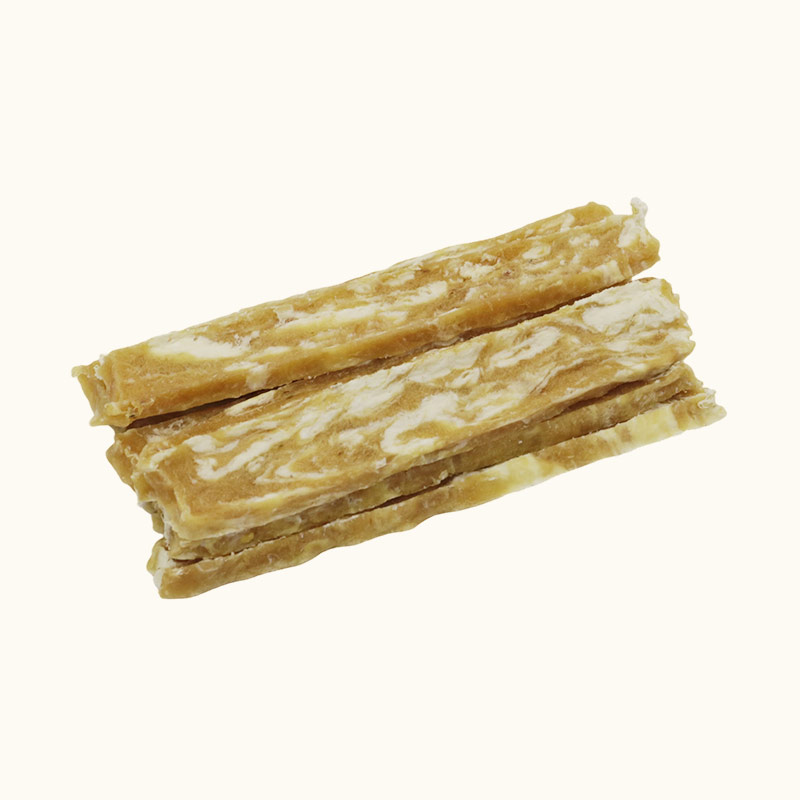
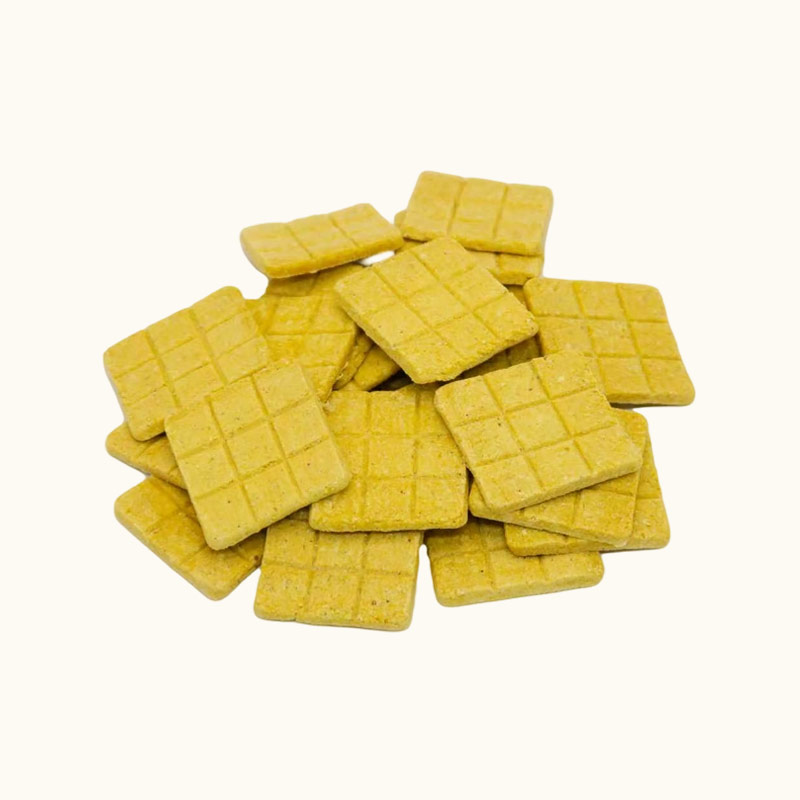
PetProOEM’s current dog treat range includes whole jerky, strips, composite bites, wrapped chews, rawhide sticks, calcium-bone products, pumpkin combinations, and other formats. These products differ in size, texture, moisture, shape, and oil content.
For a dog treat packaging project, buyers should first confirm:
- treat type;
- piece dimensions;
- piece weight;
- texture;
- moisture target;
- fat or oil characteristics;
- fragility;
- package net weight;
- target sales channel;
- expected shelf-life basis.
The packaging supplier or pet-product supplier can then recommend a structure appropriate to the actual product instead of working from a generic “dog treat bag” request.
Stand-Up Pouches Are Common for Retail Dog Treat Packaging
Stand-up pouches are widely used in the current pet-treat market because they combine a broad printable front panel, flexible sizing, relatively efficient shipping before filling, and optional resealable features. Current packaging suppliers frequently position stand-up pouches for jerky, biscuits, training treats, and other dry or semi-moist snacks. citeturn344455search0turn344455search2
For private label dog treat packaging, buyers should evaluate:
- whether the pouch stands reliably when filled;
- bottom gusset strength;
- zipper alignment where used;
- tear-notch placement;
- usable print area;
- product access;
- carton fit;
- finished-bag dimensions.
A stand-up pouch can be practical, but it should still be validated with the exact treat and fill weight.
Flat Pouches and Sachets Can Work for Samples and Small Portions
Smaller flat pouches or sachets can be useful for sample packs, trial sizes, event giveaways, single portions, or compact training treats.
They may also help brands introduce new flavors before committing to a larger retail format.
However, a small pouch has limited label space. Ingredient statements, guaranteed analysis, feeding guidance, importer information, barcode, and other required information may become difficult to arrange cleanly.
For dog treat packaging, small format should therefore be evaluated for both product fit and label readability.
Flat-Bottom and Box-Style Pouches Can Support Premium Display
Flat-bottom pouches provide more structured shelf presentation and multiple printable panels. They may suit premium jerky, gift-oriented products, or brands that want a more rigid visual appearance without using a jar or carton.
The tradeoff is that more complex pouch construction may require different manufacturing minimums and validation.
Private label buyers should compare:
- shelf stability;
- side-panel print area;
- filled appearance;
- zipper location;
- opening width;
- carton efficiency;
- handling durability.
Dog Treat Packaging Barrier Requirements Depend on the Treat
Barrier is one of the most important technical variables in dog treat packaging.
Packaging may need to control oxygen, moisture, aroma transfer, grease migration, and external contamination. The required level depends on the treat formula and processing method.
A fatty jerky product can be sensitive to oxidation. A semi-moist treat may need moisture control to maintain softness. A very dry biscuit may need protection from humidity to prevent loss of crispness. A meat-wrapped chew may need both aroma and moisture management.
Current packaging guidance for pet treats consistently emphasizes matching oxygen and moisture barrier to the product rather than selecting a film only by appearance. citeturn344455search0turn344455search8
Buyers should ask for the proposed material structure and the evidence supporting its suitability for the intended shelf life.
Do Not Copy a Competitor’s Film Structure Blindly
A film structure that works for one dog treat may be unnecessary or inadequate for another.
For example, a high-barrier laminate may be valuable for a fatty semi-moist jerky, while another treat may not need the same oxygen barrier. Conversely, a simple low-barrier bag may fail to protect a product with sensitive oils or moisture.
For private label dog treat packaging, buyers should provide the product characteristics and ask the supplier to justify the recommended structure.
PetProOEM currently confirms packaging-material customization through its OEM and ODM services, but the website does not publish one fixed packaging laminate for dog treats. That is a reason to confirm the structure by SKU, not a reason to assume one.
Resealable Zippers Can Be Useful for Multi-Serve Treats
Dog-treat bags are often opened repeatedly. A zipper can improve convenience for multi-serve packs by allowing the consumer to reclose the bag after taking out a portion.
Current market packaging guides commonly recommend resealable stand-up pouches for products that are consumed over multiple occasions. citeturn344455search0turn344455search7
For dog treat packaging, test the zipper with the actual product because crumbs, oils, and treat dust can interfere with closure.
Check:
- opening force;
- reclosure consistency;
- zipper alignment;
- product contamination in the zipper track;
- seal above the zipper before first opening;
- consumer access to larger treat pieces.
Tear Notches Need to Match the Pouch Construction
A tear notch is a small feature, but poor placement can create frustrating opening behavior.
The notch should allow the consumer to open the package without cutting through the zipper, removing too much of the top, or creating an uneven opening that interferes with reclosure.
During dog treat packaging sample review, open several filled pouches and record whether the tear path remains consistent.
Clear Windows Can Improve Product Visibility but Change the Package Structure
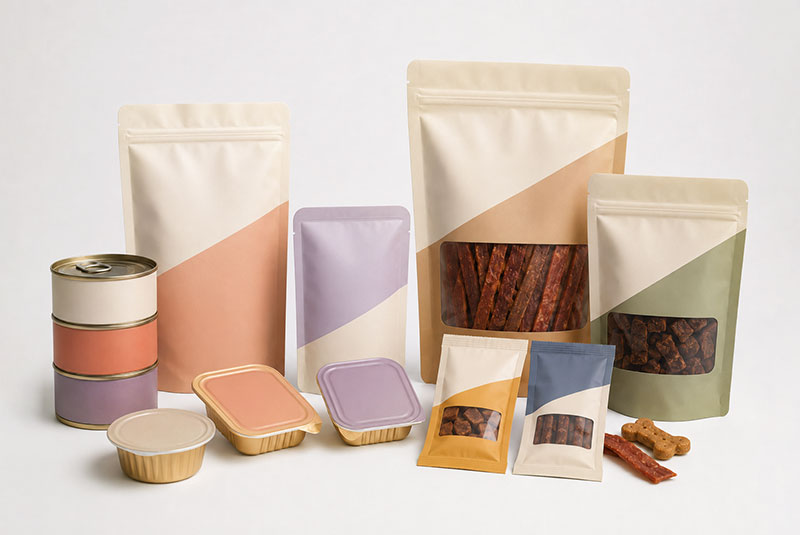
A clear window allows consumers to see the actual jerky, strips, bites, or chews inside the bag. This can strengthen trust and visual merchandising.
However, a window can change barrier performance, light exposure, print layout, and visual appearance over time.
For products with fats or color that may be light sensitive, the buyer should evaluate whether the window is appropriate.
For dog treat packaging, a clear window should be treated as a technical packaging choice, not only as a design feature.
Package Size Should Match Piece Size and Consumer Use
Net weight alone does not determine the correct bag dimensions.
Large rawhide sticks need a longer and wider pack than small training bites at the same total net weight. Irregular pieces can create more unused headspace. Flat jerky strips may stack efficiently, while bulky wrapped chews may require more volume.
PetProOEM’s current dog-treat category states that product size, weight, texture, and packaging quantity can be adjusted for different markets and sales channels.
For dog treat packaging, approve:
- net weight;
- piece count where relevant;
- bag width;
- bag height;
- gusset depth;
- headspace;
- filled appearance;
- case pack.
Training Treats and Chews May Need Different Packaging Logic
Small training treats are typically accessed frequently and may benefit from compact resealable pouches. Larger chews may be count-based, individually wrapped, or sold in longer packs.
| Product Type | Packaging Priority |
|---|---|
| Training bites | Frequent access, resealability, compact format |
| Jerky strips | Barrier, product visibility, piece protection |
| Soft treats | Moisture control, seal, repeated opening |
| Rawhide / wrapped chews | Length, shape protection, count presentation |
| Trial samples | Small pack, clear labeling, easy distribution |
This is why one dog treat packaging style should not automatically be used across every SKU.
Artwork Should Follow the Final Formula and Product Specification
Dog treat packaging contains both marketing and technical information.
Before final artwork approval, confirm:
- product name;
- animal-protein description;
- ingredient statement;
- guaranteed analysis;
- net content;
- feeding guidance;
- storage instructions;
- barcode;
- importer or distributor information;
- claims;
- lot/date-code location.
The package should match the approved formula version. If a dog treat changes from a grain-containing formula to a grain-free version, the artwork should be reviewed again rather than simply keeping the old label.
Claims on Dog Treat Packaging Need Formula-Level Support
Claims such as single ingredient, grain free, preservative free, high meat, dental, natural, or limited ingredient can strongly influence buying decisions.
They should not be copied from a category page to every SKU.
PetProOEM’s current dog-treat category describes grain-free, preservative-free, high-meat, and other customized recipe directions. At the same time, the published Chicken Jerky Whole formula contains soy protein, corn starch, glycerin, salt, and potassium sorbate.
That means the exact product formula must control the final dog treat packaging claim.
Barcodes and Retail Identifiers Should Be Confirmed Early
Private label brands should assign the correct retail identifier before mass printing.
GS1 provides global standards for GTINs and retail identification. Buyers can review GS1 GTIN guidance when planning barcodes for different SKUs and pack levels.
For dog treat packaging, verify:
- retail-unit GTIN;
- case-level code where required;
- barcode size;
- quiet zones;
- print contrast;
- location away from folds or seams;
- artwork version.
Multilingual Labels Need Version Control
PetProOEM’s services page currently confirms support for multilingual labels and carton design.
For export programs, each language version should match the same approved formula and claims.
If the ingredient list, product name, feeding instruction, importer detail, or claim changes, every relevant language version needs review.
A strong dog treat packaging workflow uses file names and version numbers rather than relying on “final-final” artwork files.
Outer Cartons Protect Retail Packs During Export
The retail pouch is only one part of the export packaging system.
Outer cartons can protect dog-treat pouches from compression, puncture, abrasion, and handling damage. They also help organize case quantity, shipping marks, barcodes, and pallet loading.
PetProOEM currently confirms outer-carton customization and export packaging support.
For buyers, useful carton fields include:
- units per carton;
- carton dimensions;
- gross weight;
- board specification;
- shipping marks;
- case barcode;
- stacking pattern;
- pallet configuration.
E-Commerce Dog Treat Packaging Needs Parcel-Level Protection
E-commerce creates different handling risks from palletized retail distribution.
Pouches may be exposed to repeated parcel drops, compression from mixed products, abrasion, and heat during last-mile delivery.
For e-commerce dog treat packaging, evaluate whether the retail pouch requires a secondary mailer or carton and whether the product can break or deform during parcel handling.
Packaging validation should reflect the actual fulfillment route rather than a generic “shipping-safe” claim.
Transport Testing Should Match the Distribution System

Packaged-product testing can simulate vibration, shock, compression, and other distribution hazards.
The International Safe Transit Association provides test procedures for different distribution environments. Buyers can review ISTA packaged-product test procedures when designing a validation plan.
For dog treat packaging, the test should be selected based on retail pouch, master carton, pallet, parcel distribution, or another actual route. Do not simply ask for “ISTA” without identifying the package and distribution system.
Environmental Packaging Claims Should Be Verified
Recyclable, recycled content, compostable, biodegradable, mono-material, and reduced-plastic claims are not interchangeable.
The U.S. Federal Trade Commission’s Green Guides explain that environmental claims should be substantiated and appropriately qualified.
For private label dog treat packaging, buyers should request the complete package structure and supporting evidence before using broad environmental language.
A kraft-paper appearance does not automatically mean a pouch is recyclable or compostable, because the package may include polymer, foil, coatings, adhesives, or other layers.
Packaging Samples Should Be Filled Before Final Approval
An empty pouch can show print quality and dimensions, but it cannot show how the actual product behaves inside.
For final approval, fill the sample with the real dog treat and check:
- pouch shape;
- shelf stability;
- product fit;
- zipper access;
- tear behavior;
- window appearance;
- seal condition;
- grease or oil migration;
- product breakage;
- carton fit.
This is one of the most practical controls in a dog treat packaging project.
Use a Packaging Specification for Repeat Orders
The approved dog-treat bag should be documented just like the product formula.
| Packaging Specification Field | What to Record |
|---|---|
| Bag format | Stand-up, flat, flat-bottom, or other approved style |
| Material structure | Supplier-defined laminate or mono-material structure |
| Dimensions | Width, height, gusset, tolerances |
| Closure | Zipper, heat seal, tear notch, other features |
| Artwork version and print method | |
| Net weight | Approved product fill |
| Outer carton | Case count, dimensions, markings |
| Test | Seal, drop, barrier, or transport checks as agreed |
This creates a stable baseline for repeat dog treat packaging orders and makes supplier-side changes easier to detect.
Dog Treat Packaging RFQ Checklist
- Treat type: jerky, strip, bite, training treat, chew, composite treat.
- Piece size: dimensions and weight.
- Product characteristics: dry, semi-moist, oily, fragile, rigid.
- Net weight: grams per retail pack.
- Sales channel: pet retail, supermarket, distributor, e-commerce, trial pack.
- Bag format: stand-up, flat, flat-bottom, or supplier recommendation.
- Barrier requirement: oxygen, moisture, aroma, grease as applicable.
- Closure: zipper, heat seal, tear notch, other.
- Window: clear window required or not.
- Artwork: logo, colors, claims, languages, barcode.
- Outer packing: carton, case quantity, pallet.
- Testing: seal, barrier, drop, transport, shelf-life support as applicable.
- Sample: empty mock-up, filled sample, pre-production pack.
Buyers can review PetProOEM’s Chicken Strip as one reference dog-treat format and send a dog treat packaging brief with the product dimensions, texture, net weight, sales channel, artwork, and shipping requirements.
Common Dog Treat Packaging Mistakes
The first mistake is selecting a pouch before understanding the treat’s moisture, fat, and size.
The second is assuming every dog treat needs the same barrier structure.
The third is approving a zipper without testing it with crumbs or product dust.
The fourth is adding a clear window without reviewing barrier and light exposure.
The fifth is approving artwork before the formula and claims are final.
The sixth is focusing on shelf appearance while ignoring export cartons and e-commerce handling.
The seventh is using recyclable or compostable claims without verifying the full package structure.
Conclusion
A reliable dog treat packaging program starts with the treat itself. Product size, texture, moisture, fat, fragility, net weight, sales channel, and intended shelf life should guide the pouch format, material barrier, closure, artwork, and shipping protection.
PetProOEM currently confirms customization of packaging formats, sizes, labels, barcodes, multilingual labels, and outer cartons, but it does not publicly specify one film laminate, zipper, window, or barrier structure for every dog treat. Buyers should therefore confirm the packaging design against the exact SKU and approve a filled sample before mass production.
The strongest private label package is the one that protects the product, communicates the formula accurately, works in the intended retail channel, and remains consistent from the first shipment to repeat orders.
FAQ
What packaging is best for dog treats?
There is no single best format. Stand-up pouches are common for jerky, bites, and training treats, while larger chews may need different dimensions or pack structures. The right choice depends on product moisture, size, barrier needs, retail channel, and shipping route.
Do dog treat bags need a zipper?
A zipper can be useful for multi-serve products that are opened repeatedly, but it is not mandatory for every treat. Buyers should test closure performance with the actual product.
Should dog treat packaging have a clear window?
A clear window can improve product visibility, but it may affect barrier, light exposure, and print layout. Buyers should confirm whether the window is suitable for the specific treat.
Can dog treat packaging be recyclable?
Potentially, depending on the full material structure and local recycling system. Buyers should verify the complete package construction and claim requirements before using recyclable wording.
What should private label buyers test before approving dog treat packaging?
Test the filled pouch for product fit, seal integrity, zipper function, opening behavior, barrier suitability, grease or moisture effects, artwork, barcode, carton fit, and transport conditions relevant to the sales channel.